
Desert Dust and Your Garage Door: Keeping Tracks and Rollers Clean Year-Round
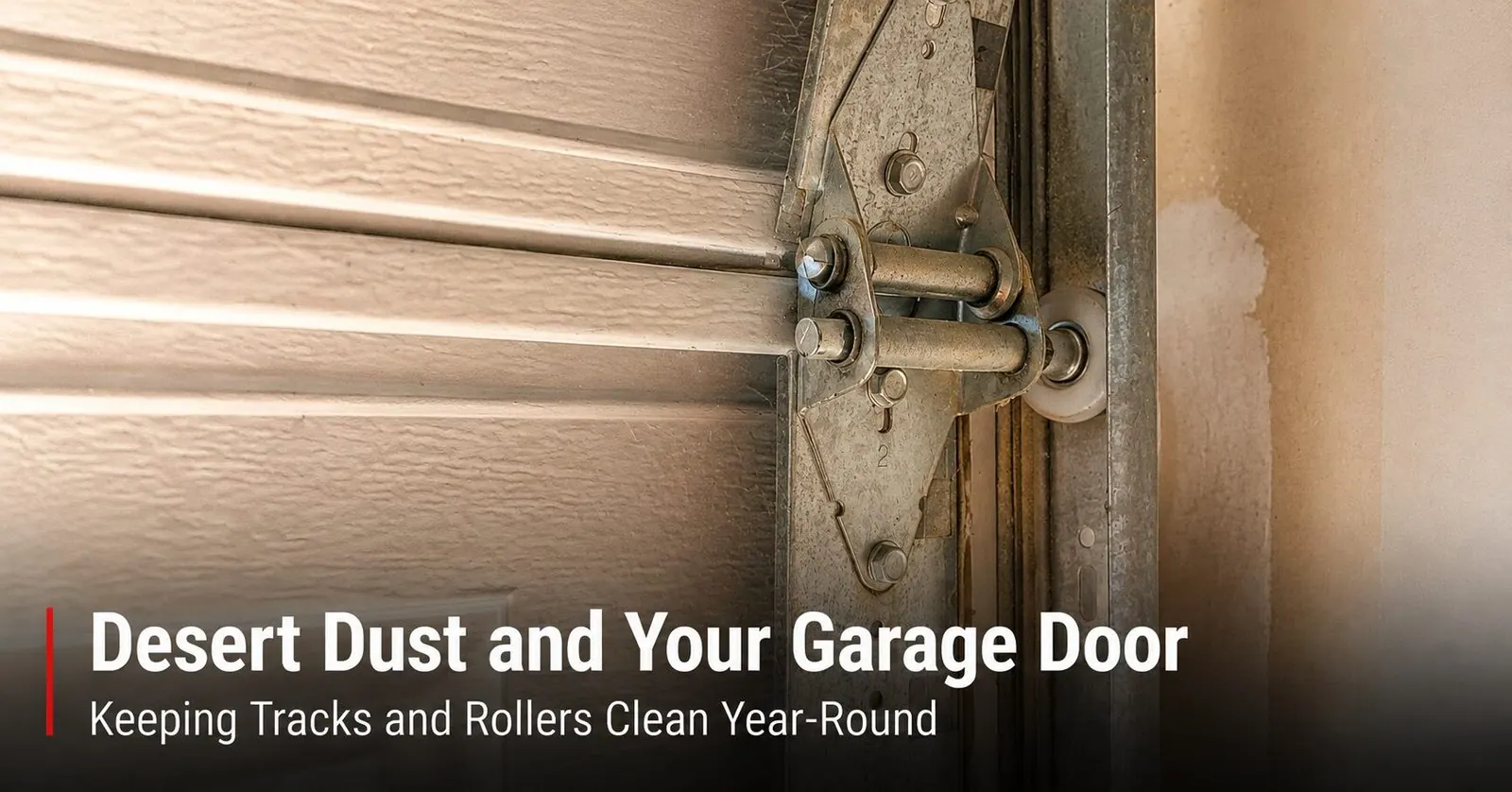
Arizona dust isn't just messy — it's abrasive, and it settles exactly where your garage door moves. Four habits keep it from wearing the door out early:
- Wipe the tracks dry, twice a year minimum — a damp rag and a dry follow-up, no cleaners needed
- Never put grease or spray lubricant in a track — it turns desert dust into grinding paste
- Spin-test your rollers — a wheel that won't turn freely is skidding, not rolling, and wearing everything around it
- Lubricate the right parts — spring coils, hinge pivots, roller stems, and the lock; nothing else
Not sure what shape yours is in? A professional tune-up covers all of it in one visit.
Every homeowner in Mesa knows the routine: you dust the shelves, and three days later there's a fresh film on everything. What most people don't think about is that the same fine grit is settling into the moving parts of the largest, heaviest thing in the house — a garage door that weighs a couple hundred pounds and travels up and down on a set of small nylon wheels.
Desert dust is not the same as dust in Ohio. It's largely silica and fine mineral particles, which means it's genuinely abrasive — closer to a very fine sandpaper than to household lint. When it works into a roller bearing or collects in a track, it doesn't just sit there. It grinds. Over a few Arizona summers, that's the difference between rollers that last a decade and rollers that need replacing in five years, and it's why so many doors in Gilbert, Queen Creek, and Apache Junction get noticeably louder without anything obviously breaking.
The good news is that dust is one of the few garage door problems you can meaningfully fight with a rag and ten minutes. Here's what to clean, what to leave alone, and how often.
Why Desert Dust Is a Mechanical Problem, Not a Cosmetic One
A garage door roller is a small wheel on a stem, and inside that stem is a bearing. The whole system works because the wheel spins freely as the door travels, letting the door glide along the track with very little friction. Everything downstream — the hinges, the track brackets, the opener motor, even the springs — is sized around the assumption that those wheels turn.
Fine grit attacks that assumption in three ways:
- It packs into bearings. Once dust works into a roller bearing, the wheel stops turning freely and starts dragging. A dragging wheel skids along the track instead of rolling, which wears a flat spot into the nylon and puts sideways load on the hinge holding it.
- It combines with lubricant. This is the one that surprises people. Grease is meant to reduce friction, but grease plus silica dust makes a lapping compound — the same principle machinists use to deliberately wear metal down. That's why lubricant in the wrong place accelerates damage instead of preventing it.
- It compounds with heat. Arizona summers thin and evaporate lubricant faster than milder climates do, so the protective film on your hinges and spring coils breaks down sooner. Dust then has bare metal to work on. Heat and dust aren't two separate problems here; they're the same problem arriving together.
The result is a door that gets gradually louder, gradually heavier for the opener to move, and eventually starts throwing off symptoms that look like something else entirely. If yours has been getting noisier, our guide to what a loud garage door is trying to tell you walks through the full list of causes.
Where the Dust Actually Collects — and What It Does There
Dust doesn't settle evenly. It concentrates in the low, horizontal, and sheltered spots — which unfortunately describes most of the door's working hardware.
| Where it collects | What the dust does there | Symptom you'll notice |
|---|---|---|
| Bottom of the vertical tracks | Grit and debris pile up in the lowest few inches, where the door sits closed most of the day | Crunching or gritty sound in the first foot of travel |
| Roller bearings | Packs into the bearing race; wheel stops spinning and starts skidding | Grinding, rhythmic squeak, flat spots on the nylon wheel |
| Hinge pivot pins | Mixes with old lubricant into an abrasive paste; wallows out the pin holes over time | Popping or creaking as sections bend at the curve |
| Photo-eye sensor lenses | A dusty lens scatters the beam, so the opener reads an obstruction that isn't there | Door starts down, then reverses back up for no reason |
| Opener rail and trolley | Coats a greased chain or screw drive, adding drag to every cycle | Opener sounds like it's working harder than it used to |
| Bottom seal and side weatherstrip | Sun-hardened rubber stops conforming to the slab, letting dust blow straight in | Dust line across the garage floor just inside the door |
| Torsion spring coils | Sticks to lubricant between coils; contributes to surface corrosion and friction | Dull, dusty-looking springs; occasional squeal on opening |
How to Clean Garage Door Tracks the Right Way
This takes about ten minutes and needs almost nothing: a rag or two, a stiff brush or old toothbrush, and a vacuum with a crevice tool if you have one. Do it with the door closed, so the vertical tracks are accessible and you're not reaching around a suspended door.
- Vacuum the loose debris first. Run a crevice tool down the inside channel of both vertical tracks, paying special attention to the bottom foot where grit, leaves, and pebbles accumulate. Getting the loose material out first means you're not just smearing it around in the next step.
- Wipe the inside of the track with a damp rag. Plain water is fine. Work from the top of the vertical section down, then reach into the horizontal track as far as you can comfortably and safely get. You're cleaning the inner channel surface the rollers actually ride on, not polishing the outside.
- Use a brush on the stubborn buildup. Old grease mixed with dust forms a dark, tacky film that a rag won't lift. A stiff brush breaks it loose. For heavily gummed tracks, a rag dampened with a mild automotive degreaser works — just wipe the residue off completely afterward.
- Dry the track completely. This step matters. A track left damp collects the next round of dust immediately. Follow the damp rag with a dry one and leave the channel bare metal.
- Do NOT lubricate the track. No grease, no spray lube, no silicone. The track is a guide surface for a rolling wheel, and any lubricant in it will collect dust and turn abrasive within weeks. Dry and clean is the correct finished state.
- Wipe the sensor lenses. While you're down there, clean both photo-eye lenses near the floor with a dry microfiber cloth and confirm both indicator LEDs are lit and steady. This ten-second step prevents a surprising number of “the door won't close” calls.
- Now lubricate the parts that should be lubricated. Using a garage door lubricant or white lithium grease: a light coat along the full length of the torsion spring coils, a drop on each hinge pivot pin, and a small amount on the roller stems where they enter the wheel. Wipe away any excess — drips catch dust. Skip WD-40 entirely; it's a solvent that strips existing lubricant rather than a lubricant that stays.
The Roller Spin Test: Your Best Early Warning
Rollers are the part dust kills first, and they're also the easiest part to check. With the door fully closed, reach up and spin each roller wheel with your fingers. A healthy roller turns freely and quietly, like a well-oiled caster. Then look at each one.
| What you find | What it means | What to do |
|---|---|---|
| Spins freely, quiet, round wheel | Healthy roller | Lubricate the stem, move on |
| Turns stiffly or grinds | Dust in the bearing | Clean and lubricate the stem; recheck in a month |
| Won't turn at all | Bearing is seized — wheel is skidding every cycle | Replace — it's damaging the track as it drags |
| Flat spot on the wheel | Roller has been skidding for a while | Replace; expect its neighbors to be worn too |
| Cracked or chipped nylon | End of service life, often heat plus dust together | Replace before it fails mid-cycle |
| Visible wobble or side play | Worn stem or failing bearing | Replace; wobble puts the door at risk of coming off track |
If two or more rollers fail, replace the whole set. They've all run the same number of cycles through the same dust, so picking off individuals just means another service call in a few months. A full set replacement also gives you the chance to upgrade — sealed nylon rollers with ball bearings resist dust intrusion far better than the basic builder-grade steel rollers many Arizona tract homes ship with, and the drop in noise is immediately obvious. Roller replacement is one of the quickest, highest-payoff visits we do.
A Year-Round Cleaning Schedule for Arizona
Dust here isn't seasonal the way snow is — it's constant, with monsoon spikes. That said, the calendar gives you natural checkpoints, and each season stresses the door differently.
| Time of year | What to do | Why then |
|---|---|---|
| Spring (Mar–Apr) | Full pass: vacuum, wipe tracks, spin-test rollers, lubricate, check seals | Wind season stirs up dust; you want the door protected before summer heat thins the lubricant |
| Early summer (May–Jun) | Quick re-lubrication of springs, hinges, and roller stems | Extreme heat evaporates lubricant faster than any other factor in Arizona |
| Monsoon (Jul–Sep) | After any major dust storm, wipe tracks and sensor lenses | A single haboob deposits more grit than months of ordinary settling |
| Fall (Oct–Nov) | Second full pass, plus a hard look at the bottom seal and side weatherstrip | Recovery from summer; seals that baked all season are usually the ones letting dust in |
| Winter (Dec–Feb) | Spot-check: listen during operation, spin any roller that sounds off | Lower dust load, and the quiet season is a good time to catch developing noise |
Clean more often if any of these apply
- Your lot backs onto desert or open land. Common along the edges of Apache Junction, Gold Canyon, San Tan Valley, and Maricopa — every wind event delivers grit straight to the door.
- You're in an active construction area. New-build neighborhoods in Queen Creek and east Mesa generate months of graded-dirt dust, and builder-grade rollers are usually the first casualty.
- You have a dirt or gravel driveway. Every arrival and departure kicks material up into the door's path.
- The door cycles a lot. Multi-driver households and home businesses can hit eight to twelve cycles a day, which multiplies the abrasion.
How this fits into overall upkeep is worth understanding too — our post on how often you should service a garage door in Arizona's heat lays out what belongs on a homeowner's list versus a technician's.
When Cleaning Isn't Enough
A cleaning pass is also an inspection. If any of these turn up, stop and call rather than pushing through:
- Bent, dented, or misaligned track. Track gap should be consistent along the whole run. A crushed section or a bracket pulled loose from the jamb needs correcting before the door jumps its channel — here's how to tell if your door is going off track and why not to force it.
- Frayed or kinked cable. Even one broken strand means the cable is on borrowed time. This is not a wait-and-see item.
- Any spring that looks rusty, pitted, or has uneven coil spacing. Spring work requires specific tools and training; it causes serious injuries otherwise.
- The door is hard to lift by hand. With the opener disconnected, a balanced door should lift with modest effort and hold roughly where you leave it. If it's heavy or slams down, the springs need adjusting.
- Noise that persists after cleaning and lubrication. If you've done the pass and it's still grinding, something is worn rather than dirty.
A professional garage door tune-up covers all of the above plus the parts homeowners shouldn't touch — balance testing, spring tension, safety reverse verification, and hardware tightening — in a single visit.
Why Neighbors Ask Farnsworth First
Farnsworth Garage Door Service was founded by brothers Brigham and Riley Farnsworth. The Farnsworth name carries 60+ years of family business across Mesa and the East Valley — R&K, Farnsworth Wholesale, Farnsworth Realty — and we've spent our careers on doors that live in this exact climate, not a national playbook written for somewhere with rain.
- We know what desert dust does to hardware. Sealed-bearing roller recommendations, correct lubrication points, seals that actually hold up to Arizona sun — that's local experience, not a script.
- Honest calls on what needs replacing. If your rollers just need cleaning, we'll tell you that. If two are seized and the rest are close, we'll show you why the set makes more sense.
- Licensed and insured Arizona ROC contractor with a 5.0-star Google rating from homeowners across Mesa, Gilbert, Chandler, and the wider Phoenix area.
- Same-day service is our standard — often within hours of your call.
Frequently Asked Questions
Should I grease my garage door tracks?
No — and in Arizona this is the mistake we correct most often. Tracks are a guide surface, not a bearing surface. The rollers are supposed to roll along them, not slide through grease. Any lubricant you put in a track immediately becomes flypaper for desert dust, and within weeks you have a gritty paste that grinds roller wheels flat and packs into the bearings. Tracks get wiped clean and left dry. Lubricant belongs on the spring coils, the hinge pivot pins, the roller stems, and the lock — never the track, and never the nylon roller wheel itself.
How often should I clean my garage door tracks in Arizona?
Twice a year is the baseline for most Mesa and Gilbert homes: once in spring before the heat arrives, and once in fall after monsoon season has thrown its dust around. Some situations call for quarterly cleaning — homes backing onto desert or open land, houses in active construction areas like parts of Queen Creek and San Tan Valley, dirt or gravel driveways, and any door that cycles more than about eight times a day. It takes ten minutes with a rag, so when in doubt, do it more often.
What does a dust-worn garage door roller sound like?
The classic signs are a gritty grinding or crunching as the door travels, a rhythmic squeak that repeats with each rotation, or a rumble that gets louder as the door picks up speed. Grit-packed bearings stop the wheel from spinning freely, so the roller starts skidding along the track instead of rolling. That skidding is what wears flat spots into the wheel and puts sideways load on the hinges and track. A door that got noticeably louder over one season usually has rollers to blame.
How do I know if my garage door rollers need replacing?
Do the spin test. With the door closed, spin each roller wheel by hand — a healthy roller turns freely and quietly. Look for flat spots on the wheel, cracked or chipped nylon, visible play where the stem meets the wheel, and any roller that won't turn at all. If two or more rollers fail the test, the whole set should be replaced rather than picking off individuals, since they've all seen the same cycles and the same dust. Never spin or touch the bottom rollers on a door with a broken spring, and never remove a bottom roller bracket — it's under cable tension.
Are nylon rollers better than steel in the desert?
For most Arizona homes, yes. Nylon rollers with sealed ball bearings are quieter and, more importantly here, the sealed bearing keeps fine desert dust out of the part that matters. Basic builder-grade steel rollers often have exposed bearings that pack with grit and seize. Steel rollers still make sense in heavy commercial applications where load matters more than noise, but on a residential door in Mesa or Apache Junction, a sealed nylon roller is usually the better long-term choice — and the difference in how quietly the door runs is immediately noticeable.
Can dust make my garage door reverse or refuse to close?
It can, in two different ways. First, the photo-eye safety sensors near the floor sit right where dust settles, and a dusty lens can scatter the beam enough that the opener thinks something is in the way — so the door starts down and reverses. Wiping both lenses with a dry microfiber cloth fixes that in seconds. Second, grit-bound rollers create real drag, and an opener that senses extra resistance will stop or reverse because that's exactly what its safety system is designed to do. If cleaning the lenses doesn't solve it, the resistance is mechanical and worth having looked at.
Does keeping the garage door closed keep the dust out?
It helps, but a closed door isn't a sealed door. Dust gets in through a hardened bottom seal that no longer conforms to the slab, gaps in the side and top weatherstripping, and the small gaps around the door frame. Arizona sun bakes rubber and vinyl until they harden and shrink, so seals that worked when the house was new often aren't sealing five years later. Checking the perimeter seals is part of the same maintenance pass as cleaning tracks, and a good seal cuts both the dust and the heat coming into the garage.
Can I clean and lubricate the door myself, or should I call someone?
Wiping tracks, cleaning sensor lenses, spinning rollers to check them, and applying garage door lubricant to hinges and spring coils are looking-and-cleaning tasks — nothing there is under tension. What is a different category: anything involving the springs themselves, the cables, the bottom roller brackets, or track alignment. Those components are under extreme tension or hold the door's weight, and a mistake there causes serious injuries. If your cleaning pass turns up bent track, frayed cable, rollers that won't spin, or a door that's noticeably harder to lift by hand, that's the point to hand it to a technician.

Let the Dust Settle Somewhere Else
Clean tracks, free-spinning rollers, and the right lubricant in the right places — we'll handle the whole pass and tell you honestly what needs attention. Book a visit and get a quote for anything we find.