
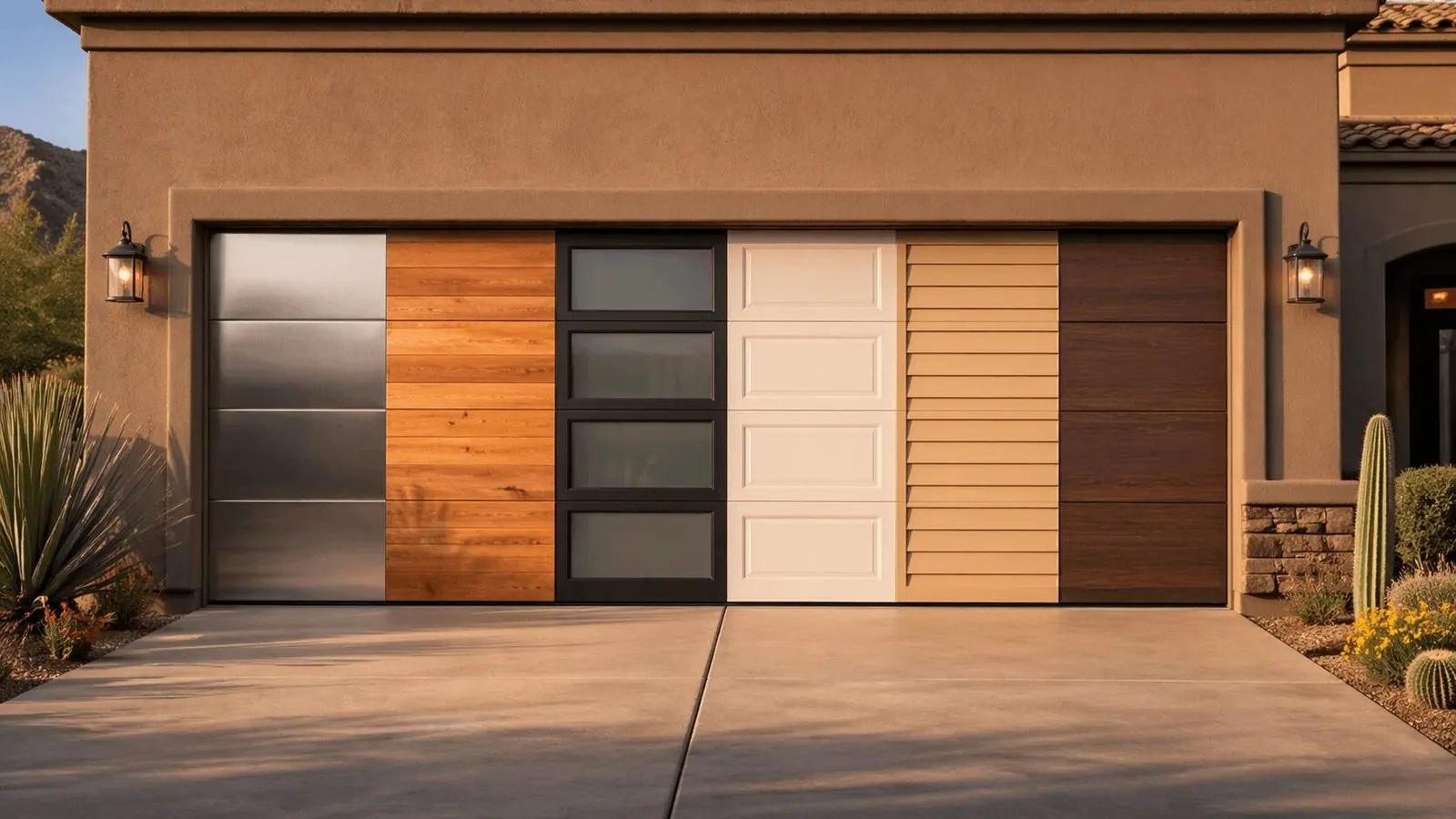
Garage Door Materials Compared
Every garage door material has trade-offs. The right choice depends on your climate, your home's architecture, your budget, and how much maintenance you're willing to do. Here's an honest look at each option — with specific notes on how each one performs in Arizona's desert environment.
Steel
The workhorse of the garage door industry and the material on the large majority of new residential doors in Arizona. Steel won't warp, crack, or dry out in desert heat the way organic materials can, and factory-applied finishes resist UV fading for 15+ years. It comes in raised panel, flush, carriage house, and contemporary profiles, on 24- to 27-gauge galvanized skins.
Steel is not one product, though — it's three. Every steel door you're quoted is built one of three ways, and that choice does more to determine how hot your garage gets than the brand or the panel style ever will. The three builds are laid out below.
The Three Steel Builds — Choose One
Same material, same brands, same panel designs. The difference is what's behind the front skin — and that's what you feel in July.
Steel Pan — Single Layer
One layer of formed steel, open on the back. No insulation at all. It's the least expensive door built, and on an attached Arizona garage it's the one that turns the room into an oven by mid-morning.
Vinyl-Back — Two Layer
A steel front panel with insulation held against it by a vinyl backing sheet. A real step up from a pan door without much added cost, and a sensible pick for a detached garage or a shop you don't cool.
Steel-Back — Three-Layer Sandwich
Steel on the front, an insulation core in the middle, and a finished steel skin on the back. Stiffer, quieter, and far better at keeping heat out. This is what we put on attached garages.
A note on vinyl: on a garage door, vinyl is almost always the backing used in build 2 — not the door itself. True all-vinyl doors do exist, and Wayne Dalton's Model 8700 is one, but it's built for pool-adjacent and high-abuse garages rather than maximum insulation, so we rarely quote it here.
Real Wood
Nothing matches the warmth and character of a solid wood garage door — cedar, redwood, mahogany, and hemlock are the most common species. Custom wood doors are hand-built and can be designed to match any architectural style, from rustic Southwest hacienda to modern horizontal slat. However, Arizona's intense UV radiation and extreme dryness are wood's biggest enemies. Without annual sealing and re-staining, wood doors fade, dry, crack, and can warp within just a few seasons. Expect to invest 3–5 hours of maintenance annually. Wood also offers moderate insulation (R-6 to R-10) compared to polyurethane-core steel. Best suited for custom homes where the aesthetic is worth the upkeep commitment.
Aluminum & Glass
Aluminum-framed full-view doors are the signature look of contemporary and mid-century modern architecture. Narrow aluminum stiles hold tempered safety glass panels — available in clear, frosted, tinted, mirrored, or insulated (dual-pane) configurations. Aluminum is naturally rust-proof, making it an excellent choice for Arizona's occasional dust storms and monsoon humidity. It's also the lightest material option, which reduces wear on openers and springs. The downside: aluminum dents more easily than steel and offers limited insulation unless you opt for insulated glass panels. Powder-coated or anodized finishes resist UV degradation and come in a wide range of colors including matte black, dark bronze, and white.
Fiberglass
Fiberglass garage doors are made from glass-fiber-reinforced polymer over a steel or wood frame. They're lightweight, resist denting, and won't rust or corrode — a meaningful advantage in Arizona's monsoon season when humidity spikes. Fiberglass also handles UV exposure better than wood, though prolonged direct sun can cause gradual yellowing or chalking over many years. Translucent fiberglass panels allow diffused natural light into the garage without full glass exposure. Fiberglass is a solid mid-range option, though it's less widely available than steel and offers fewer style choices. Not ideal if dent resistance is a top priority — fiberglass can crack on hard impact rather than denting.
Wood Composite
Wood composite doors use recycled wood fibers bonded with resin and pressed over a steel or insulated core. The result looks and feels remarkably like real wood — complete with wood-grain texture — but without the warping, cracking, and rot that plague solid wood in Arizona's climate. Composite resists insects (no termite risk), handles UV exposure far better than natural wood, and only needs occasional repainting every 5–7 years. Clopay's Canyon Ridge® Collection and Safe-Way's Madera wood-tone finishes are two excellent options we install regularly. If you love the look of a wood carriage house door but don't want the annual maintenance, composite is the answer.
Material Comparison at a Glance
Use this table to quickly compare the five materials across the factors that matter most in Arizona — heat resistance, insulation, maintenance, and longevity.
| Material | Heat Resistance | Best R-Value | Durability | Maintenance | Dent Resistance |
|---|---|---|---|---|---|
| Steel | Excellent | R-19.40 | Excellent | Very Low | Very Good (24 ga) |
| Real Wood | Poor (cracks/warps) | R-0 to R-4 | Good (with care) | High (annual) | Moderate |
| Aluminum & Glass | Excellent | R-0 to R-4 | Very Good | Very Low | Low (soft metal) |
| Fiberglass | Good | R-11 | Good | Low | Moderate (cracks on impact) |
| Wood Composite | Very Good | R-20.4 | Very Good | Low (repaint 5–7 yr) | Good |
* R-values based on manufacturer specs for top-tier configurations. Actual performance varies by door model, weather-stripping condition, and installation quality.
Why Insulation Matters More in Arizona Than You Think
Most people associate garage door insulation with keeping cold out. In Arizona, it's the opposite — insulation keeps extreme heat out of your garage and, more importantly, out of the wall your garage shares with your air-conditioned home. Here's what actually happens on a 115°F July afternoon:
The difference between no insulation and full polyurethane isn't just comfort — it's money. Heat radiates through the shared wall into your air-conditioned home, forcing your AC to run harder, and an insulated door cuts that load down.
How Garage Door Insulation Is Built
Not all insulation is equal. The construction method determines how well the door actually blocks heat in real-world conditions — not just on a spec sheet. These are the same three steel builds described above, shown in cross-section.
Single-Layer — Steel Pan
One steel skin, open behind it. No insulation, so heat transfers straight through. Fine for a detached garage or shed where temperature doesn't matter.
Two-Layer — Vinyl-Back
A steel front skin with insulation held in place by a vinyl backing sheet. A genuine improvement over a pan door, and the usual choice for a garage you don't cool.
Three-Layer — Polystyrene Core
Rigid foam board between two steel skins. Decent insulation, but it leaves air gaps at the edges and doesn't bond to the steel, so panels can feel hollow.
Three-Layer — Polyurethane Core
Liquid foam injected between two steel skins, expanding to fill every void. It bonds to both skins for maximum strength, insulation, and sound deadening. This is the gold standard.
Polystyrene vs. Polyurethane: What's the Real Difference?
These two words sound similar, but the performance gap is significant. Here's the head-to-head:
Polystyrene (EPS Foam Board)
Pre-cut rigid foam boards are placed between steel skins. Because the boards are a fixed shape, they can't fill irregular spaces — leaving air gaps at edges and around hardware cutouts that reduce real-world R-value below what the spec sheet claims. The foam doesn't bond to the steel, so panels can rattle and feel less solid.
Polyurethane (Injected Foam)
Liquid foam is injected between the steel skins and expands to fill every cavity — around hinges, around hardware, into every corner. It bonds permanently to both steel surfaces, creating a rigid sandwich panel that resists dents, deadens noise, and delivers the R-value it promises. This is the method Clopay uses in their Intellicore® line.
Steel Gauge: What the Numbers Actually Mean
If you're shopping for a steel garage door, you'll see "gauge" numbers thrown around — 24 gauge, 25 gauge, 27 gauge. Here's what it means and why it matters: the lower the gauge number, the thicker and stronger the steel. It's counterintuitive, but a 24-gauge door is significantly more dent-resistant than a 27-gauge door.
24 Gauge — Premium
The thickest steel used in residential garage doors. Highly dent-resistant — handles hail, basketballs, and the occasional ladder lean without showing damage. Used in premium models from Clopay (Premium Series, Canyon Ridge, Bridgeport), Amarr (Lincoln, Classica, Stratford), and Safe-Way (Aristocrat, SteelHouse). Our standard recommendation for any new installation.
25 Gauge — Mid-Range
A solid middle ground that balances cost and durability. Used in mid-tier models like Clopay Classic and Gallery Collections, Amarr Heritage and Hillcrest, and Safe-Way's Choice series. Adequate for most residential use but shows dents more easily than 24-gauge, especially on raised-panel profiles where the flat sections are wider.
26–27 Gauge — Economy
The thinnest residential steel. Fine for a detached garage or a strict-budget replacement, but noticeably more prone to dents and oil-canning (wavy distortion in flat panel areas). If you're investing in a door for your primary home's attached garage, spending a little more for 24- or 25-gauge steel is worth it — the dent resistance and structural feel of a heavier-gauge door is immediately noticeable.
What We Recommend for Arizona Homes
After installing and servicing hundreds of garage doors across Mesa, Gilbert, Chandler, Scottsdale, and the greater Phoenix area, we've seen how every material holds up in our specific desert conditions. Here's what we recommend based on real-world experience — not just manufacturer brochures.
- Best Overall Value: Insulated steel with polyurethane core, 24-gauge, R-12 or higher. Handles everything Arizona throws at it — 115°F summers, monsoon dust, UV exposure — with virtually zero maintenance. This is what we install on most jobs.
- Best for Modern Homes: Aluminum full-view with insulated glass panels. Rust-proof, lightweight, and pairs perfectly with the contemporary architecture that's exploding across Scottsdale, Tempe, and North Gilbert. Opt for tinted or low-e glass to reduce solar heat gain.
- Best Wood Look (Without Wood Problems): Steel or composite with factory-applied wood-grain finish. Clopay Coachman and Safe-Way's Madera wood tones are our top picks — they look like real wood from the street but won't crack, warp, or need annual staining. Perfect for craftsman, Spanish, and farmhouse-style homes.
- Best for Families: Vinyl on a steel frame. Color-through construction means scratches from bikes, scooters, and basketballs disappear. Virtually indestructible for everyday family life. Choose a model with polystyrene core for decent insulation.
- Best for Detached Garages / Budget: Non-insulated single-layer steel, 25-gauge. Gets the job done at the lowest price point. If the garage is detached and not climate-controlled, insulation is less critical — put the savings toward a better opener instead.
- When Real Wood Makes Sense: Custom estate homes where the door is a signature architectural element and the homeowner is committed to annual maintenance. We'll always be honest — real wood is gorgeous, but it's a commitment in this climate. If you're on the fence, composite gives you 90% of the look with 10% of the upkeep.
Not Sure Which Material Is Right for You?
Every home is different, and so is every budget. Our team will walk you through all the options in person — materials, insulation levels, styles, and brands — so you end up with the door that fits your home, your taste, and your budget. No pressure, no upselling. Just honest guidance from people who do this every day. Schedule a free consultation or call us at (602) 935-9766.
Brands We Install: Matched to Every Material
We don't carry every door on the market — we carry the ones that consistently perform in Arizona's climate, hold up to daily use, and are backed by real warranties. Compare all six side by side on our garage door brands page, or see how material choice interacts with panel design in our garage door styles guide. Here are the brands we trust, organized by the materials they do best.
Clopay® — Steel, Composite & Aluminum Leader
The largest residential garage door manufacturer in North America and the only brand with the Good Housekeeping Seal. Their Intellicore® polyurethane insulation is industry-best — liquid-injected to fill every void for maximum R-value and structural strength. Key collections: Gallery (entry-level steel), Classic (mid-range steel), Premium Series (24-ga insulated), Canyon Ridge (composite carriage house), Coachman (steel with wood-look overlay), and Avante (aluminum + glass contemporary). R-values range from R-0 up to R-20.4 on Canyon Ridge, with Intellicore steel topping out at R-18.4.
Amarr® — Steel & Safety Focus
Amarr builds some of the safest residential doors available with their SafeGuard™ pinch-resistant panels — a must-have for households with children. Strong dealer network, recycled steel content, and EPA SmartWay sustainability commitment. Key collections: Heritage (economy steel), Olympus (mid-range), Lincoln (premium 24-ga polyurethane), Classica (carriage house), and Stratford (top-tier carriage). R-values up to R-16.
Wayne Dalton — Enclosed Springs & Wood Grain Impressions
Wayne Dalton is the pick when you’d rather not have a spring strung across the ceiling: TorqueMaster® Plus seals the spring inside a steel tube above the opening. On the finish side, their Wood Grain Impressions™ range includes Cedar Plank and Western Cedar looks on steel, and the Classic Steel 8500 reaches R-16.22 with a polyurethane core. Lifetime rust-through coverage on steel sections.
Safe-Way — Arizona-Engineered Steel & Madera Wood Tones
Safe-Way engineers its doors in Tempe for desert homes, and the details show it. The Ambient series reaches R-17.68 with a thermal break in the section seal, and SteelHouse uses true dimensional 23-gauge steel overlays instead of a shape stamped into the panel. Their Madera wood tones — Oak, Rosewood, and Driftwood — carry a 10-Year Finish Warranty on the wood-look doors.
Invicta Door — Galvanized Steel at a Straightforward Price
Invicta builds on hot-dipped galvanized steel, which is the part that matters most in a climate that swings from monsoon humidity to bone-dry heat — the zinc coating goes on before the panel is formed, so the steel is protected at the edges and seams where corrosion usually starts. Seven panel series run from the Series 100 short raised panel up to the Novus (Model N18), a flush door with integrated wood-tone panels in varying lengths and no repeating pattern. Each series comes in three builds — non-insulated, polystyrene insulated, or a polyurethane sandwich — so you can match the insulation to whether your garage is attached. Sold only through certified installers, not big-box stores.
Frequently Asked Questions
How long do different garage door materials last?
Insulated steel: 20–30 years with minimal maintenance. Aluminum & glass: 20+ years — rust-proof and durable. Wood composite: 20–25 years with occasional repainting. Vinyl: 20+ years, virtually maintenance-free. Fiberglass: 15–20 years. Real wood: 15–20 years, but only with consistent annual maintenance — neglected wood doors in Arizona can deteriorate much faster due to UV and dry heat.
What is the most affordable garage door material?
Non-insulated single-layer steel is the most budget-friendly option. However, for Arizona homeowners with attached garages, the small step up to an insulated steel door is almost always worth it — the difference in how the garage feels during our brutal summers is immediate, and your AC works less for it. We're happy to quote both options side by side so you can see the real cost difference.
Should I choose steel or aluminum for a modern garage door?
It depends on the look you're going for. For a full-view glass door (the floor-to-ceiling window look), aluminum frames with tempered glass panels are the standard — lightweight, rust-proof, and available in sleek powder-coated finishes. For a modern flush-panel look without glass, steel is the better choice: it's stronger, more dent-resistant, offers better insulation, and costs less. Both materials hold up exceptionally well in Arizona. If you're unsure, our technicians can bring samples to your home so you can see and feel the difference in person.
What is the best garage door material for Arizona heat?
Insulated steel with a polyurethane core (R-12 to R-19.40) is the best all-around choice for Arizona's extreme heat. The triple-layer construction reflects radiant heat and keeps garage temperatures significantly cooler — most homeowners notice a 10–20°F difference compared to a non-insulated door. Steel won't warp, crack, or degrade in prolonged 110°F+ exposure, and factory-applied finishes resist UV fading for 15+ years. For attached garages in Mesa, Gilbert, and Chandler, insulated steel dramatically reduces the heat load on your home's AC system.
Can I get a wood look without using real wood?
Absolutely — and in Arizona, it's usually the smarter move. Steel doors with factory-applied wood-grain finishes (like Clopay Coachman or Safe-Way Madera) look remarkably like real wood from the street but won't crack, warp, or need annual staining. Wood composite doors (like Clopay Canyon Ridge) go a step further with real wood-fiber texture pressed over an insulated core. You get the warmth and character of wood with a fraction of the maintenance — no sealing, no staining, no worrying about Arizona's UV and dry heat destroying your investment.
What garage door material adds the most home value?
A new garage door consistently ranks as one of the highest-ROI home improvement projects in the country. According to the 2025 Cost vs. Value Report, a garage door replacement returned an average of 268% of its cost at resale — a $4,672 job that added $12,507 in resale value, ranking first of all 28 projects measured. Insulated steel and wood composite doors tend to deliver the best return because they combine curb appeal with durability. In Arizona's market, an insulated steel door with a modern or carriage house design is the sweet spot: it looks great, performs well in our climate, and appeals to the widest range of buyers.
Do I need a permit to replace my garage door in Arizona?
In most Phoenix-area cities — including Mesa, Gilbert, Chandler, and Scottsdale — a standard like-for-like garage door replacement does not require a building permit. However, if the project involves changing the opening size, modifying the header or framing, or adding electrical work for a new opener, a permit may be required. HOA communities may also require architectural approval before changing the door style or color. We handle this regularly and can let you know exactly what applies to your situation during a free on-site estimate.
What's the quietest garage door material?
Triple-layer insulated steel with a polyurethane core is the quietest option. The foam fills every cavity between the two steel skins, which dampens vibration and significantly reduces noise during operation. Pair it with a belt-drive or direct-drive opener and nylon rollers, and you'll barely hear the door move — a big deal if you have bedrooms above or next to the garage. Single-layer steel and aluminum doors tend to be the loudest because there's nothing to absorb the vibration.
Ready to Choose Your New Garage Door?
Get a free, no-pressure quote on any material — we'll bring samples to your home, measure your opening, and recommend the best option for your budget and style.