
EV Charging in the Garage: What Arizona Homeowners Should Know About Doors and Heat
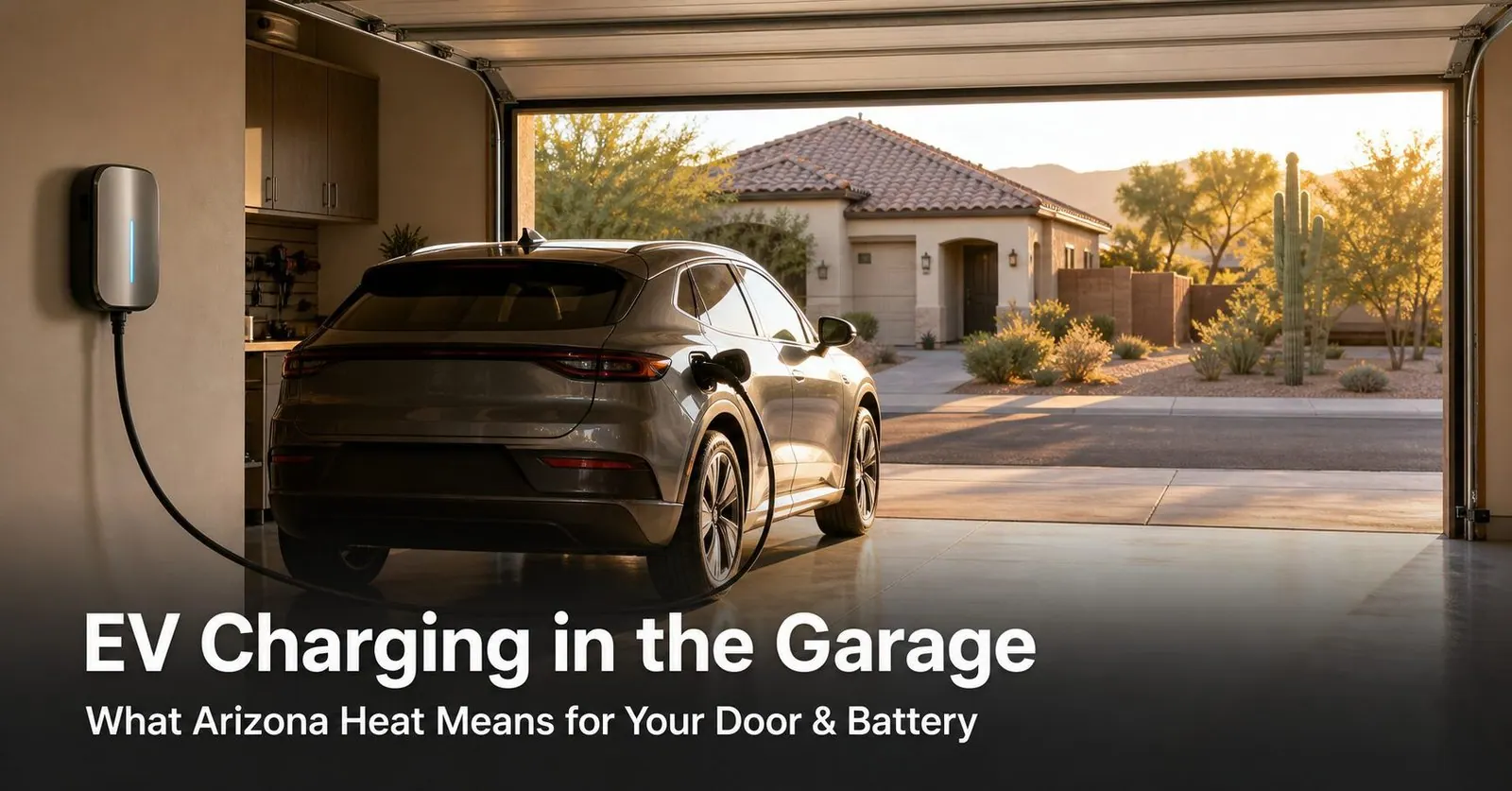
Charging an EV in an Arizona garage is safe — but a blazing-hot garage quietly costs you charging efficiency and long-term battery health. Four things move the needle:
- The garage door is the biggest heat gateway in the room — an uninsulated steel door soaks up afternoon sun and radiates it inside all evening, right when you plug in
- Insulation and fresh weather seals lower the garage's resting temperature more than any other envelope upgrade
- Charger placement matters — keep the unit and cable clear of tracks, springs, the opener rail, and the door's travel path
- Plan for outages — know your opener's manual release, and consider battery backup so a monsoon outage never traps the car
Thinking about a door upgrade as part of an EV-ready garage? Start with our garage door installation service.
Drive through any neighborhood in Mesa, Gilbert, or Chandler in the evening and you'll see it: charging cables snaking from wall units to EVs parked where the lawnmower used to live. The garage has quietly become a fueling station — and that changes how much its temperature matters. In most of the country, a warm garage is a comfort issue. In the Phoenix area, where an enclosed garage can sit dramatically hotter than the already-triple-digit air outside, it becomes a battery issue. Lithium-ion batteries are famously heat-sensitive, and the hours your car spends charging in that oven are exactly the hours heat does its slow damage. The good news: the biggest lever for cooling the space is one you may already be thinking about replacing anyway — the garage door. Here's the full picture.
Why Heat Is the Enemy of EV Charging
Every EV on the road manages its battery temperature carefully, because lithium-ion chemistry has a comfort zone — and an Arizona garage in July is well outside it. When the battery is hot, three things happen:
- The car spends your electricity on cooling. During charging, a hot battery pack forces the vehicle to run its thermal management system — pumps, fans, sometimes the air-conditioning compressor. Some of the energy flowing from your wall goes into cooling hardware instead of the battery.
- Charging can slow down. To protect the pack, many vehicles reduce charging power when battery temperature climbs too high. In a garage that stays hot deep into the night, that can stretch out the overnight charge during the very months you drive the most air-conditioned miles.
- Long-term heat exposure ages the battery. This is the quiet one. Sustained high temperatures are one of the best-documented accelerators of lithium-ion degradation. A car that lives and charges in a cooler garage simply holds its range longer than one parked in an oven every summer for a decade.
None of this makes garage charging unsafe — EVs and home chargers are engineered for hot climates. It makes it less efficient and harder on the battery, which for most owners translates to the same thing: money.
What Your Garage Door Has to Do With It
Here's the part most EV guides skip. Your garage's temperature is set by its envelope — walls, ceiling, and the single biggest opening in the room: the garage door. On most homes that door is a wall of steel facing the driveway, and if it's a builder-grade single-skin door, it works like a radiator in reverse. The afternoon sun heats the steel, the steel radiates into the garage, and the space keeps cooking long after sunset — exactly the window when most EVs are plugged in. We've written before about why Phoenix garages get so hot and how the door drives it; an EV in the garage turns that from a comfort topic into a running-cost topic.
Insulation: the biggest single upgrade
Insulated doors are built as a sandwich — steel skins around a polystyrene or polyurethane core — and the difference shows up in the R-value. Builder-grade doors sit at effectively R-0; quality insulated residential doors run from the mid single digits up to roughly R-18 for premium polyurethane construction. For a garage that doubles as a charging bay, polyurethane-core doors in the R-12-and-up range are the sweet spot: they slow solar heat gain through the largest surface in the room and help the garage shed heat faster in the evening. Our guides to insulated vs non-insulated doors in Phoenix heat and what R-value actually matters in Arizona break down the numbers.
Seals: the cheap upgrade that punches above its weight
An insulated door with daylight showing around its edges is a cooler with the lid cracked. The bottom seal, side and top weatherstripping, and the threshold together keep out three things Arizona has in abundance: hot air, dust, and critters looking for shade. Worn seals are common on homes across Mesa, Gilbert, and Queen Creek because the sun cooks the rubber — if yours are cracked or flattened, our post on why the bottom seal matters in AZ dust and monsoon season covers the symptoms, and a full perimeter reseal is a quick professional visit.
Color and finish
A dark door on a west-facing elevation absorbs meaningfully more solar heat than a light or reflective finish. If you love the modern black look, insulation matters even more; if you're choosing fresh, a lighter exterior color on the sun-facing side is free thermal performance.
| Garage upgrade | How it helps EV charging | Effort level |
|---|---|---|
| Insulated (polyurethane) garage door | Slows solar heat gain through the room's largest surface; garage cools faster after sunset, when charging happens | Door replacement — biggest impact, do it when the door is due |
| Full perimeter weather seals | Blocks hot-air infiltration, dust, and critters; makes any insulation actually count | Quick professional visit |
| Light exterior door color / reflective finish | Reduces solar absorption on sun-facing elevations | Free choice at replacement time |
| Opener battery backup | Door still works in a monsoon outage — the EV never gets trapped | Opener upgrade or replacement option |
| Ventilation or dedicated cooling | Actively removes trapped heat; pairs with (doesn't replace) a sealed, insulated envelope | Separate trade — HVAC or electrician |
Charger Placement and the Door Hardware Around It
The electrical side of an EV charger — panel capacity, the 240-volt circuit, the outlet or hardwired unit — is licensed-electrician territory, full stop. But the location of that charger lives in garage door territory, and we've seen placements that made us wince. A quick orientation to what moves in your garage:
- The vertical and horizontal tracks run up both sides of the opening and back along the ceiling. The door's rollers travel through them every cycle — nothing should be mounted to them, near their fasteners, or in the path of the door's curve from vertical to horizontal.
- The torsion shaft and springs sit directly above the door opening. That hardware is under extreme tension and needs clear access for service — don't mount a charger, conduit, or cable hooks on that header area.
- The opener rail runs from the motor head (mid-ceiling) to the wall above the door. Keep cable runs from crossing it.
- The door's travel path sweeps a big arc. A charging cable draped through it — or across the threshold where the door seals — will eventually get pinched, and a pinched high-voltage cable is a bad day. Park, plug, and keep the cable inside the door line.
Cooling Strategies, Ranked for Arizona Garages
Think of it as a ladder — each rung matters more if the ones below it are in place:
- Seal it first. Fresh perimeter weatherstripping and a solid bottom seal are the foundation. Without them, insulation and cooling both leak away.
- Insulate the biggest surface. The door, then the ceiling if the attic above is unconditioned. An insulated door with good seals meaningfully lowers the garage's resting temperature and evens out the day-night swing.
- Move the air. A properly installed exhaust fan can dump trapped heat in the evening — useful in a sealed, insulated garage, nearly pointless in a leaky one.
- Condition it if you must. A mini-split turns the garage into genuinely conditioned space. It's the premium path, and it only makes financial sense after the envelope work above — you don't air-condition a room with a bare steel wall facing the western sun.
Notice the pattern: the garage door work comes first, and it's also the work that pays off even if you never add active cooling.
Future-Proofing: The EV-Ready Garage Checklist
Whether the EV is in the driveway already or on next year's wish list, here's what we'd put on the punch list for an Arizona home:
- Door: insulated polyurethane construction, light or reflective exterior finish on sun-facing elevations, pinch-resistant panel design if kids share the garage. If your current door is due anyway, this is the moment — our installation team can walk you through insulated options for your opening.
- Seals: full perimeter package — bottom seal, side and top weatherstripping, threshold if the driveway slopes toward the house.
- Opener: battery backup so a storm-season outage never strands the car; a smart opener is a natural companion to a car you already control from your phone.
- Layout: charger placed clear of tracks, springs, and rail; cable route that never crosses the door line; the emergency release cord reachable and every driver in the house shown how to use it.
- Habits: charge overnight when the garage is coolest, and give the door's seals a quick look each fall — the summer sun is hard on rubber here.
Why Neighbors Ask Farnsworth First
Farnsworth Garage Door Service was founded by brothers Brigham and Riley Farnsworth. The Farnsworth name carries 60+ years of family business across Mesa and the East Valley — R&K, Farnsworth Wholesale, Farnsworth Realty — and we've watched the Valley's garages evolve from storage rooms into workshops, gyms, and now charging stations.
- Straight talk on insulation. We'll tell you which R-value actually makes sense for your garage and orientation — not just the most expensive door on the truck.
- Full-envelope thinking. Door, seals, and opener as one system — because insulation without seals is money out the gap.
- Licensed and insured Arizona ROC contractor with a 5.0-star Google rating from homeowners across Mesa, Gilbert, Chandler, and the wider Phoenix area.
- Same-day service is our standard — often within hours of your call.
Frequently Asked Questions
Is it safe to charge an EV in a hot Arizona garage?
Yes. EVs and their charging equipment are built to operate safely across a wide temperature range, and a properly installed charger on its own dedicated circuit is designed for exactly this job. The real issue in Arizona isn't safety — it's efficiency and battery health. Charging in a very hot garage forces the car to spend energy cooling its battery while it charges, and long-term exposure to extreme heat accelerates battery aging. Cooling the space down — starting with the garage door, the biggest heat gateway in the room — is about protecting your investment, not preventing a hazard.
Does garage heat actually slow down EV charging?
It can. Most EVs actively manage battery temperature, and when the battery is hot the car runs its cooling system during charging — which diverts some of the electricity you're paying for away from the battery. In extreme heat some vehicles also reduce charging speed to protect the pack. In a Phoenix-area garage that can sit far above outdoor temperature all evening, that means slower, less efficient overnight charging during the hottest months. A cooler garage charges more of your money into the battery.
Will an insulated garage door really make a difference for EV charging?
It makes more difference than any other single change to the garage envelope. The door is usually the largest opening in the room, and a single-skin steel door soaks up afternoon sun and radiates that heat inside well into the night — exactly when most EV owners charge. A polyurethane-insulated door (roughly R-12 and up) with fresh perimeter seals meaningfully slows that heat transfer. It won't turn the garage into a refrigerator, but paired with weather sealing it takes the edge off the worst hours and helps the whole space recover faster after sunset.
Where should an EV charger be mounted relative to the garage door?
Keep the charger and its cable path clear of everything that moves: the vertical and horizontal door tracks, the torsion spring shaft above the opening, the opener rail, and the door's full travel path. A wall position near the front corner of the parking bay usually works well. Never route the charging cable across the threshold where the door closes, and never drape it over or near the tracks — a cable caught in moving door hardware is bad for the cable, the door, and your wallet. Your electrician handles the circuit; if you're not sure whether a spot conflicts with door hardware, we're happy to take a look.
What happens to my EV if the power goes out during a monsoon storm?
Charging simply stops and resumes when power returns — the car is fine. The bigger question is whether you can get the car out of the garage. Every opener has a manual release cord that disconnects the door so you can lift it by hand, and every EV household should know where it is. Better still, many modern openers offer battery backup that keeps the door working through an outage — an upgrade worth real consideration in a storm-season household that depends on the garage to get on the road.
Should I choose a specific garage door if I'm buying an EV?
If a new door is on the horizon anyway, an EV is a good reason to prioritize three things: real insulation (polyurethane construction rather than a bare steel skin), a light-reflective exterior color or finish on sun-facing elevations, and a complete seal package around the perimeter. Together they lower the garage's resting temperature — better for the battery, better for charging efficiency, and more comfortable for the humans plugging in. It's the same door you'd choose for a hot Arizona garage in general; the EV just raises the payoff.
Does an EV charger installation involve the garage door company or an electrician?
The charger circuit itself is licensed-electrician work — panel capacity, wiring, and the outlet or hardwired unit all belong to them. Where a garage door company comes in is the room around it: making sure the charger location doesn't conflict with tracks, springs, or the opener rail; upgrading the door's insulation and seals so the space stays cooler; and setting up the opener side of things, like battery backup. For a garage that's becoming a daily fueling station, it's worth having both trades look at the space.

Make Your Garage EV-Ready
From insulated doors and fresh seals to battery-backup openers, we'll help your garage keep its cool — and your battery keep its range. Book a visit and get a written quote for your setup.