
Garage Door Weather Seals in Arizona: Stopping Heat, Dust, and Critters
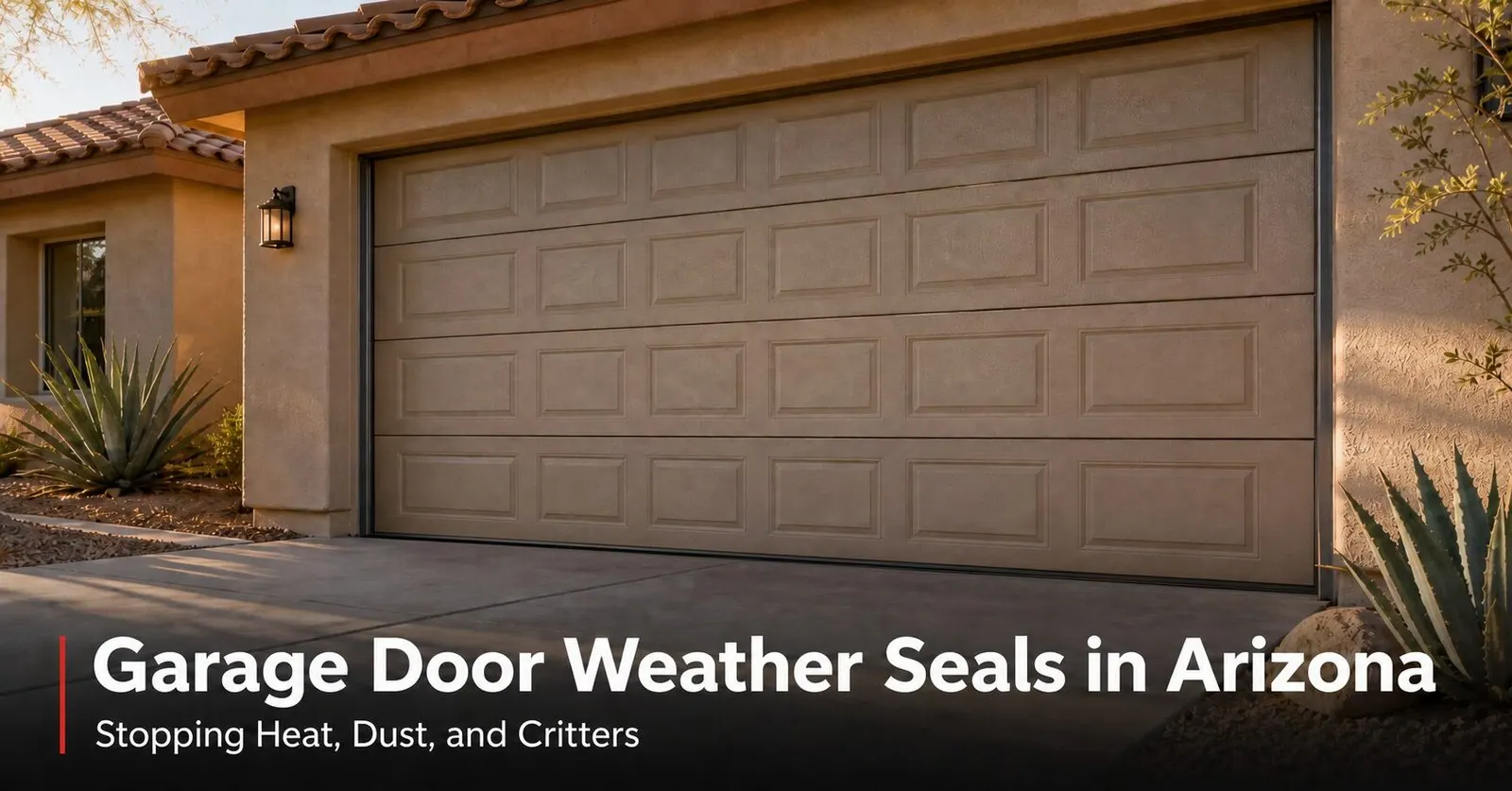
Your garage door doesn't have a weather seal — it has three or four, and in Arizona all of them fail on the same schedule:
- Bottom seal (astragal) — the rubber strip on the door's bottom edge; the one everybody knows about
- Side seals — vertical strips on the door frame, not the door; the most commonly ignored
- Top header seal — caps the opening across the top, bakes in direct sun all summer
- Threshold seal — optional strip glued to the floor, for slabs that aren't level
Close the door, kill the lights, and look for daylight around the perimeter. Any line of light is heat, dust, and a pest entry point at once. Weather stripping and bottom seal replacement is one of the fastest, least expensive things you can do for a garage.
There's a specific moment most Mesa homeowners have in August. You walk into the garage at four in the afternoon, and it hits you like opening an oven — except you also notice a fine sand-colored line on the floor just inside the door, and something small skitters into a corner. All three of those things trace back to the same failure, and it's usually a strip of rubber that costs less than a tank of gas.
Garage door weather seals are the least glamorous part of the whole system. Nobody upgrades their seals for curb appeal. But in the Phoenix area they do more work than almost any other component, because they're standing between a conditioned-ish garage and 115-degree air, blowing dust, monsoon runoff, and a desert full of creatures actively looking for shade.
They also fail invisibly. A spring breaking makes a bang; a seal failing just quietly stops sealing over about four summers. Here's how the whole perimeter works, what our climate does to it, and how to check yours in five minutes.
The Four Seals on a Garage Door
When someone calls us about "the garage door seal," they almost always mean the bottom one. That's fair — it's the one you can see, and it's the one that gets stepped on, driven over, and dragged across concrete thousands of times. But a garage opening is a rectangle, and sealing one edge of a rectangle leaves three edges open.
| Seal | Where it lives | What it stops | How it fails here |
|---|---|---|---|
| Bottom seal (astragal) | Slides into a retainer channel on the bottom edge of the door itself | Water, dust, most pests, and the biggest single air gap | Rubber hardens and takes a permanent flat set, so it stops conforming to the slab; ends shrink and open up at the corners |
| Side seals (jamb / stop molding) | Nailed or screwed to the wood jamb on both sides — on the frame, not the door | Blowing dust, driven rain, insects, and side-draft air movement | Vinyl fades chalky white, goes brittle, and cracks; nails back out of sun-dried jamb wood |
| Top header seal | Mounted on the header above the opening, contacts the top section when closed | Rising heat, wind-driven dust, roof-line pests coming down the wall | Takes the most direct sun of any seal; often the first to crack and the last one anyone checks |
| Threshold seal | Adhered to the garage floor, forming a low ramp the door closes against | Water and pests where a sloped or settled slab leaves gaps a bottom seal can't bridge | Adhesive releases in extreme slab heat; edges lift and peel where tires cross daily |
If you've been dealing with a specific bottom-seal issue — visible light underneath, water creeping in during a storm — our post on why a cracked bottom seal matters in Arizona dust and monsoon goes deeper on that one component.
What Arizona Sun Actually Does to Seal Rubber
Seal manufacturers publish lifespans based on a national average climate. Those numbers don't survive contact with a Gilbert driveway.
Two things are happening at once. UV radiation breaks down the polymer chains in rubber and vinyl from the surface inward, which is why an old seal looks chalky and gray instead of black, and why it powders when you rub it. At the same time, sustained heat drives out the plasticizers — the additives that keep the material flexible. Strip those out and what's left is stiff and brittle rather than springy.
The practical result is a seal that's still physically there but has stopped doing its job:
- It takes a permanent set. A good bottom seal squashes when the door closes and rebounds when it opens. A baked one stays squashed — permanently flattened into whatever shape it was last compressed into, which won't match your slab.
- It shrinks lengthwise. This is why gaps appear at the two bottom corners first even when the middle still looks fine. The material has physically contracted.
- It cracks at flex points. Side seals crack where the door's edge rubs them; bottom seals split along the fold line.
- The fasteners let go. Sun-dried jamb wood loses its grip on nails, so side seal strips pull away from the frame at the top before the rubber itself has failed.
A west- or south-facing garage takes the worst of it. If your opening catches full afternoon sun from May through September, expect to be on a shorter replacement cycle than the neighbor whose garage faces north — same street, same house, meaningfully different seal life.
Not sure if yours are past it? Call or text (602) 935-9766Critters: What Fits Through a Failing Seal
This is the section that makes people fix their seals faster than any energy-efficiency argument ever has. Arizona's wildlife spends the summer looking for two things — shade and moisture — and an attached garage offers both. The gap under a hardened door seal is one of the most reliable entry points on the entire house.
| What gets in | Gap it needs | Why the garage |
|---|---|---|
| Bark scorpions | About the width of a credit card — they're built flat | Cool concrete, dark clutter, and the insects that are already in there |
| Roof rats | Roughly the size of a quarter | Well established across the Phoenix metro; garages offer nesting material, shelter, and stored pet food |
| Crickets & other insects | Almost any visible gap | They're the food source that draws scorpions and spiders in behind them |
| Black widows | Any gap at all | Undisturbed corners, and they follow the insects |
| Snakes (occasionally) | A gap about the height of a pencil | Shade during summer heat; more common on lots backing desert in Apache Junction, Gold Canyon, and Queen Creek |
| Blown dust & monsoon runoff | Any gap | Wind drives fine grit through openings you can barely see; storm water follows the slope of the driveway |
How Much Heat a Perimeter Gap Really Lets In
Here's the honest version, because we'd rather set the right expectation than oversell a strip of rubber.
Sealing the perimeter makes a real, noticeable difference to how a garage behaves — but it's an air-leakage fix, not an insulation fix. A quarter-inch gap running the full width of a sixteen-foot door adds up to a meaningful opening, and hot outside air doesn't politely stay outside. It pours in low all afternoon, and at night the cooler air you've managed to accumulate drains right back out. Closing that loop is why homeowners tell us the garage stops feeling like a wind tunnel of hot air the day after new seals go on.
What seals can't do is change the surface area math. Your door panel is well over a hundred square feet of material facing the sun; the perimeter gap is a fraction of that. If your garage is genuinely unbearable, seals are step one and the door itself is step two — our guide to why your garage gets so hot in Phoenix and how your door affects it covers the full picture, and insulated vs. non-insulated doors in Phoenix heat weighs whether the upgrade earns its keep.
The reason to start with seals is simple: it's the cheapest, fastest move on the list, it addresses dust and pests at the same time, and it's a prerequisite for everything else. Insulating a door while leaving a gap around it is like running the AC with a window cracked.
The Five-Minute Perimeter Inspection
Do this in the fall, after summer has done its worst. No tools required.
- Close the door and turn off the garage lights. Stand inside and let your eyes adjust for thirty seconds. Then look at all four edges. Every line or pinhole of daylight is an air gap, a dust gap, and a pest gap simultaneously. Note where they are.
- Check the two bottom corners specifically. This is where shrinkage shows first. A seal can look perfect across the middle and still have a half-inch triangle of daylight at each end.
- Press the rubber with your thumb. Healthy seal material compresses and springs back. Failed material feels stiff and stays dented, or leaves chalky residue on your thumb. Do this in a few spots along the bottom and up both sides — they don't fail evenly.
- Look at the side seal fasteners. Walk the two vertical strips and check whether nails or screws have backed out of the jamb. A strip that's loose at the top is only sealing the bottom half of the opening.
- Look up at the header seal. Almost nobody does this one. Open the door partway, look at the strip on the header above the opening, and check for cracking, curling, or a strip that's simply missing.
- Check the slab, not just the seal. If the concrete under the door is cracked, sloped, or visibly settled, a new bottom seal alone won't close the gap. That's what a threshold seal is for.
- Do the hot-afternoon hand test. On a hot day, run your hand slowly along the closed perimeter. Where you feel a distinct rush of warm air, you've confirmed the light test from the other direction.
What to Replace Yourself — and What to Hand Off
Weather seals are one of the more DIY-friendly parts of a garage door, with a few real limits. Here's the honest split.
| Job | Reasonable DIY? | What's involved |
|---|---|---|
| Side seals / stop molding | Yes — the friendliest one | Pry the old strip off the jamb, cut the new one to the opening height, fasten it so it just kisses the door face. Basic trim work. |
| Top header seal | Yes, with a ladder | Same idea as the sides, overhead. Work with the door open and the opener unplugged so nothing moves while you're up there. |
| Bottom seal — retainer in good shape | Usually yes | Take a sample of the old seal to match the profile (T, J, or bead — they're not interchangeable), slide the old one out, feed the new one in with soapy water as lubricant. |
| Bottom seal — retainer bent or corroded | No | Replacing the retainer means working at the bottom brackets, which are under lift-cable tension even with the door closed. This is where DIY seal jobs turn into injuries. |
| Threshold seal | Yes, but measure twice | Position is everything — set wrong, it traps runoff on the garage side instead of shedding it. Dry-fit with the door closed before any adhesive touches concrete. |
| Gaps caused by a crooked or unbalanced door | No | Cable, drum, and spring tension work. New seals won't solve it, and the components involved are the dangerous ones. |
The one detail that trips up most homeowners buying seal at a big-box store: bottom seal profiles aren't universal. A T-style astragal won't stay in a J-channel retainer, and even within T-style there are different slot widths. Cut a two-inch sample off your old seal and match it physically rather than eyeballing a package on a shelf.
If you'd rather not sort through profiles and ladders, seal replacement is a natural add-on to a garage door tune-up, where the whole perimeter gets checked alongside balance, rollers, and safety reverse in one visit.
Why Neighbors Ask Farnsworth First
Farnsworth Garage Door Service was founded by brothers Brigham and Riley Farnsworth. The Farnsworth name carries 60+ years of family business across Mesa and the East Valley — R&K, Farnsworth Wholesale, Farnsworth Realty — and we've built our work around doors that live in this climate, not a national playbook written for somewhere it rains.
- We check the whole perimeter, not just the bottom. Sides, header, slab condition, and door balance — because a new bottom seal on a crooked door is money spent on the wrong problem.
- We carry the profiles that actually fit. T-style, J-type, and bead seals in the sizes Arizona tract builders used, so a repair doesn't turn into a parts-hunting trip.
- Straight answers about what needs doing. If your seals have another season in them, we'll say so.
- Licensed and insured Arizona ROC contractor with a 5.0-star Google rating from homeowners in Mesa, Gilbert, Chandler, and across the Phoenix area.
- Same-day service is our standard — often within hours of your call.
Frequently Asked Questions
How many weather seals does a garage door have?
Most residential doors have three, and some have a fourth. The bottom seal (also called an astragal) runs along the bottom edge of the door and rides in a retainer channel. Two side seals, sometimes called jamb seals or stop molding, run vertically up both sides of the opening and are attached to the door frame rather than the door. A top header seal caps the opening across the top. A fourth piece, a threshold seal, glues to the garage floor and is added when the slab is uneven or sloped enough that the bottom seal alone can't make full contact. Most homeowners only ever think about the bottom one, which is why the other three are usually the ones failing.
How long do garage door weather seals last in Arizona?
Considerably less time than the manufacturer's general estimate, because our UV load and heat are extreme. A bottom seal that might last eight to ten years in a mild climate is often hardened and shrunken here in about half that. Side and top seals fail even faster when the opening faces west or south and takes direct afternoon sun all summer. The practical answer for Mesa, Gilbert, and Chandler homes is to check the full perimeter every fall, after the summer has done its damage, and plan on replacing seals as maintenance items rather than waiting for them to fall apart.
Can scorpions and roof rats get in under a garage door?
Yes, and the garage door is one of the most common entry points on an Arizona home. Bark scorpions are famously flat and can squeeze through a gap roughly the width of a credit card, which is smaller than the gap a hardened, shrunken bottom seal leaves at the corners. Roof rats, well established across the Phoenix metro, need only a gap about the size of a quarter. Crickets, black widows, and the occasional snake looking for shade all use the same route. Restoring a full-perimeter seal doesn't replace pest control, but it closes the door — literally — on the easiest way in.
Why is there a gap at the corner of my garage door even though the seal looks fine?
Corner gaps usually mean the seal has shrunk rather than worn. Vinyl and rubber contract as they age and bake, and the shrinkage shows up at the ends first because that's where the material has somewhere to pull away to. It can also mean the door isn't sitting level when closed, which points to an uneven cable drum or a travel-limit setting on the opener rather than the seal itself. If both bottom corners show light but the middle is tight, replace the seal. If only one corner shows light, have the door's balance and cable tension checked, because a seal won't fix a door hanging crooked.
Do garage door weather seals actually help with heat in Phoenix?
They help, but they're one piece of a bigger picture. A perimeter gap lets superheated outside air pour straight into the garage all afternoon, and it lets the cooler air you do have leak out at night, so sealing the perimeter makes a real difference in how fast the space heats up and how long it stays that way. What seals can't do is fix a thin, uninsulated door — the door panel itself is a much larger surface area than the perimeter gap. Seals plus an insulated door work together; either one alone gets you partway.
Can I replace garage door weather stripping myself?
The side and top seals are reasonable homeowner projects — they're nailed or screwed to the wood jamb, and swapping them is basic trim work with a pry bar and a nail gun or screws. A bottom seal is usually doable too when the retainer channel is in good shape: you slide the old one out and feed the new one in with soapy water. Where people get into trouble is a corroded or bent retainer that has to come off the bottom section, because that means working near the bottom brackets, which are under lift-cable tension. If the retainer itself needs replacing, hand it off.
What is a threshold seal and do I need one?
A threshold seal is a rubber or vinyl strip that adheres to the garage floor rather than the door, forming a low ramp the door closes against. It's the fix for a slab problem, not a door problem — sloped driveways, settled or cracked concrete, and floors that were never poured level all leave gaps a bottom seal can't bridge no matter how new it is. Thresholds are common in older Phoenix and Tempe neighborhoods where slabs have shifted. They do change how water drains and can trap runoff on the garage side if placed wrong, so position matters more than the product.
How do I check my garage door seals without any tools?
Close the door, turn off the garage lights, and look for daylight. Any line of light along the bottom, up either side, or across the top is an air gap, a dust gap, and a pest gap all at once. Then press the seals with your thumb — healthy rubber gives and springs back, while failed rubber feels stiff, chalky, or crumbles at the edges. Finally, run your hand along the perimeter on a hot afternoon; a rush of warm air where there shouldn't be one tells you the same thing the light test does. The whole check takes about five minutes.

Seal the Whole Opening, Not Just the Bottom
Bottom, sides, header, threshold — we'll check the full perimeter, match the right profile, and tell you honestly what needs replacing. Book a visit and get a written quote.