
New House, Old Garage Door: A First-Year Checklist for Arizona Homebuyers
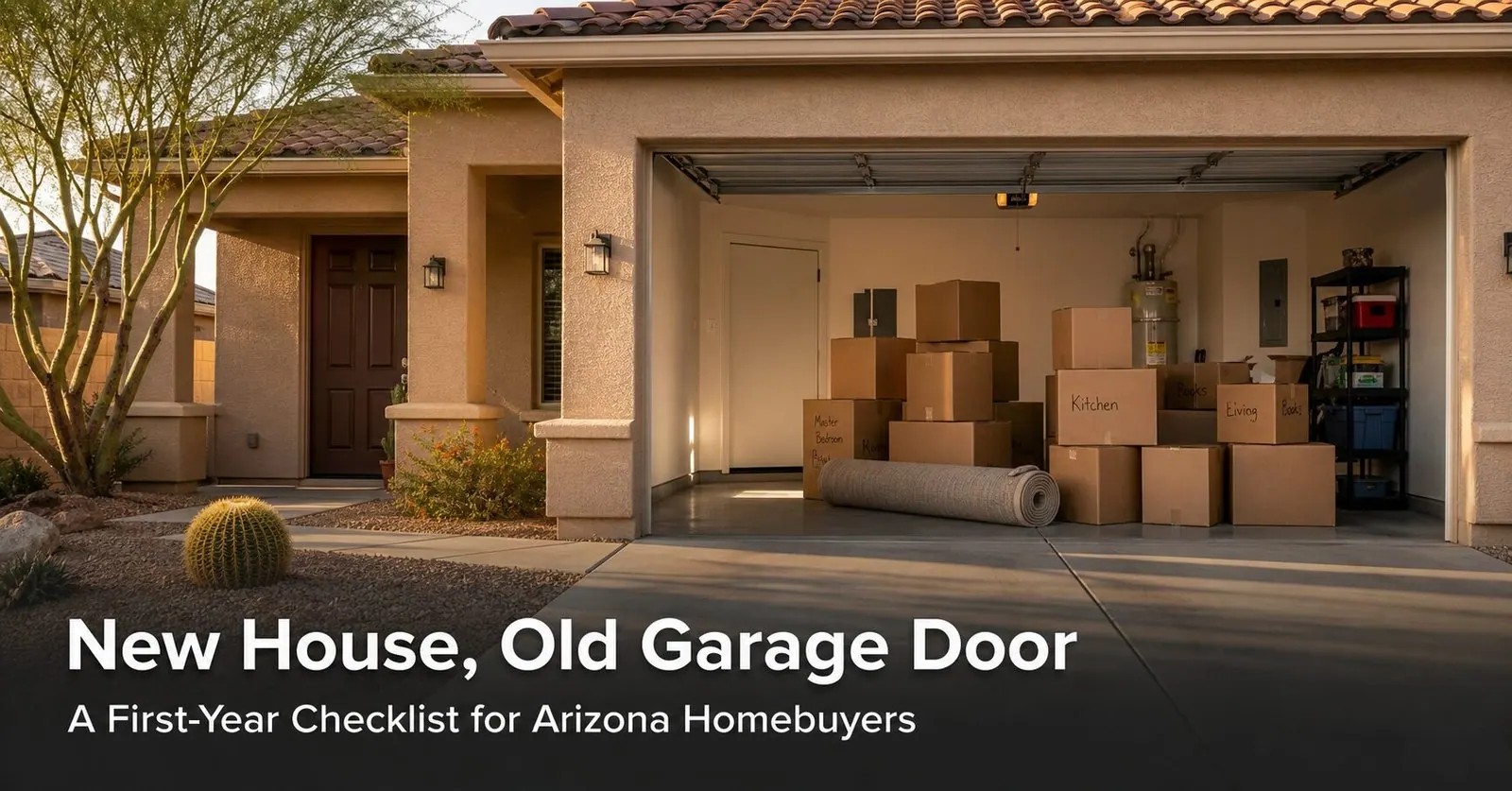
When you buy a house, you inherit a garage door with no history. Here's the first year in four moves:
- Week one — reset the security. Erase every remote and keypad stored in the opener, then reprogram only the ones you hold
- Week one — run three safety tests. Photo-eye sensors, physical auto-reverse, and the manual release cord
- Month one — find out what you inherited. Opener model and date, door age, spring condition, and any signs of a DIY repair
- Before your first full Arizona summer — get a professional set of eyes on it so you know where the system actually stands
The fastest way to close the information gap is a professional garage door tune-up, where a technician checks every component and tells you straight what shape it's in instead of leaving you to guess.
You closed on the house. The boxes are in the living room, the utilities are switched over, and somewhere in a folder is a home inspection report that says something like garage door operates as intended.
That line is doing a lot of work it was never meant to do.
Here's the thing about a garage door: it's the largest moving object in the house, it's the door most Arizona families actually use as their main entrance, and it's the one system in the purchase where you have almost no history. You know when the roof was replaced because it was in the disclosure. You know the AC's age because the inspector wrote it down. But nobody can tell you how many times that door has gone up and down, whether anyone ever lubricated the rollers, or whether the previous owner had a spring replaced by a professional or by a brother-in-law with a YouTube tab open.
This checklist closes that gap. It's built around what we actually find on first visits to recently sold homes in Mesa, Gilbert, Chandler, and Queen Creek — and it's organized by when to do it, not by how hard it is.
What Your Home Inspection Did — and Didn't — Tell You
Home inspectors do valuable work under real time pressure. In a few hours they cover roofing, plumbing, electrical, HVAC, foundation, appliances, and everything in between. The garage door gets a few minutes, and those minutes are spent confirming that it moves and that the sensors work.
That's a reasonable scope. It just isn't a garage door inspection, and the difference matters more here than it would in a milder climate.
| Check | Typical home inspection | Why it matters in Arizona |
|---|---|---|
| Door opens and closes | Yes — usually one cycle | A door can run fine and still be badly out of balance, which quietly destroys the opener |
| Photo-eye sensor reversal | Usually tested | Good. This is the one safety item most reports do cover |
| Physical auto-reverse (contact) test | Sometimes skipped | The sensors and the contact reverse are two separate systems. One passing doesn't mean the other does |
| Balance test with opener disconnected | Rarely | This is the single best indicator of spring health, and springs are the most common failure here |
| Spring condition and remaining cycle life | No | Heat and daily thermal cycling shorten spring life. Age alone doesn't tell you where you stand |
| Cable fraying, kinks, or splices | No | A single broken strand is a warning. A splice is a repair that should never have happened |
| Roller wear and track gap | No | Desert dust in roller bearings is one of the top wear accelerators in the Valley |
| Weather seal condition | Occasionally noted | Sun-baked seals go chalky and stop sealing, which lets in heat, dust, and pests |
| Opener age, force settings, travel limits | No | Force settings cranked up to compensate for a heavy door is a common and dangerous shortcut |
None of this means your inspector missed something they should have caught. It means the report answered a narrower question than most buyers assume it answered.
Week One: The Security Reset
This is the most important item on the entire list, it costs nothing, and most new homeowners never do it.
When you take possession of a house, you change the locks. Everybody knows that. But the garage door is a door, and it has its own set of keys in the form of remotes and keypad codes — and unlike house keys, you have no way of counting how many exist.
Think about who might still have a working remote for your new garage: the previous owners and their adult kids, a house cleaner, a landscaper, a contractor who worked on the place before it listed, the neighbor who fed the cat. Every one of those remotes still opens your door until you erase it.
- Find the LEARN button on the motor head. It's on the back or side of the opener unit, often under a light cover, and it's usually colored. You'll need a step stool.
- Press and hold it until the indicator light goes out. On most residential openers this takes several seconds and erases every remote and keypad paired to the unit at once. Check your opener's manual for the exact behavior of your model.
- Reprogram only the remotes you physically hold. If a remote didn't come with the house or isn't in your hand right now, it doesn't get reprogrammed.
- Set a new keypad PIN. Don't keep the code the sellers left you, and don't use the house number. If the keypad buttons are visibly worn on four keys, that's a hint anyone can read.
- Unplug or remove the emergency release from outside access. If there's an exterior release lock or a gap above the door that a coat hanger could reach, address it. Our guide to garage door lock and security upgrades walks through the options.
- Check for a wall-console lock feature. Many openers have a vacation or lockout mode that disables all remotes. Worth knowing where it is before your first trip.
Week One: Three Safety Tests You Can Run Yourself
These take about five minutes total and require nothing but a broom and a piece of scrap lumber.
1. The photo-eye sensor test
Close the door with the opener, and while it's moving, wave a broom handle through the beam near the floor. The door should stop and reverse immediately. If it keeps going, or if it stops without reversing, that's a problem to correct before you use the door around children or pets. Blinking sensor LEDs usually mean misalignment, which is common in a house that just had furniture hauled through the garage. We cover what the lights mean in our post on how garage door safety sensors work.
2. The contact auto-reverse test
Lay a solid object flat on the floor in the door's path — a two-by-four laid flat is the standard — and close the door. When the bottom of the door touches it, the door should reverse within roughly two seconds. This is a completely separate system from the sensors, and a door can pass one test and fail the other. If it fails, do not adjust the opener's force settings to push through it. A door that won't reverse on contact needs a technician.
3. The manual release and balance check
With the door fully closed, pull the emergency release cord to disconnect the opener. Lift the door by hand. It should feel manageable and move smoothly. Raise it to about waist or chest height and let go — a properly balanced door holds within about six inches of where you left it. If it slams shut or races upward, the springs are no longer carrying the door's weight correctly, and your opener has been compensating for it.
While the opener is disconnected, practice reconnecting it too. In a monsoon-season outage you don't want to be learning that mechanism by flashlight for the first time.
Failed a safety test on your new home's door? Call or text (602) 935-9766Month One: Figure Out What You Actually Inherited
Once the boxes are unpacked, spend twenty minutes with a flashlight and your phone camera building a small file on the system. Future you will be grateful, and so will whoever services the door.
- Opener model and date. There's a label on the side or back of the motor head with a model number and usually a manufacture date or date code. Photograph it.
- Door manufacturer and age. Often a sticker on the inside face of a section or on the bottom bracket. Photograph that too.
- Spring setup. Look above the opening. Torsion springs mount on a single shaft above the door; extension springs run along the horizontal tracks on either side. Note which you have and whether both springs look like a matched set.
- Overall condition. Photograph the tracks, the bottom seal, and the rollers. In a year you'll have a comparison point.
Then use the age to set your expectations. Arizona is hard on this equipment, and a door that would be middle-aged in a mild climate is often further along here.
| System age | What's typically fine | What to watch for |
|---|---|---|
| Under 5 years | Springs, opener, panels, hardware | Builder-grade springs and rollers on tract homes wear faster than owners expect. Lubrication is often the only thing needed |
| 5–10 years | Door sections, tracks, opener motor | Rollers grinding, weather seals cracking, and springs entering the second half of their cycle life |
| 10–15 years | Steel sections usually still sound | Original springs are on borrowed time, opener gears and circuit boards start failing, and safety features may be dated |
| 15–20 years | Track and framing, if undamaged | Expect multiple components near end of life at once. Opener replacement is often the better value than repeated repair |
| 20+ years | Little, without documentation | Insulation, safety features, and hardware are a generation behind. Worth evaluating the door as a whole rather than piece by piece |
For a fuller picture of what to expect from each part of the system in this climate, see how long a garage door lasts in Arizona.
Signs a Previous Owner Tried to Fix It Themselves
This is the part of a home purchase nobody discloses, because usually nobody remembers to. These are the things we find on first visits to recently sold homes, and each one is a reason to have the system looked at rather than assumed sound.
| What you see | What it usually means | How concerned to be |
|---|---|---|
| Two springs on the shaft that don't match | One was replaced and the other wasn't, or the replacement wasn't sized to the door | High — mismatched springs put uneven load on the whole system |
| A cable with a kink, a clamp, or a splice | A homeowner repair. Garage door cables are never spliced | High — stop using the door and have it inspected |
| Hardware-store bolts or hose clamps in place of brackets | Improvised hardware substituted for the correct part | High if it's on the bottom bracket or spring anchor, which are under load |
| Tracks that were hammered back into shape | Something hit the door and the dent was worked out rather than the track replaced | Moderate — the door will bind and the rollers will wear unevenly |
| Heavy oily spray on the tracks | The wrong lubricant in the wrong place. Tracks are meant to stay dry | Moderate — in the desert it collects dust into an abrasive paste |
| Opener bolted to ceiling drywall with no framing behind it | A DIY opener install that skipped the structural mounting | High — the mount carries real load every cycle |
| Sensors mounted well above the floor | Someone raised them to stop nuisance reversals instead of fixing the cause | High — sensors belong near the floor to catch a child or pet |
| Rust streaks or heavy pitting on springs | Long-term moisture exposure or simply age and no lubrication | Moderate to high — pitted springs fail earlier than clean ones |
When to Book the First Professional Visit
Everything above is homeowner-level work. Here's where a technician earns their keep: telling you what a decade of unknown history actually left behind.
A proper inspection covers the springs, cables, rollers, hinges, tracks, weather seals, and opener; lubricates the springs, hinges, rollers, and locks (never the tracks); adjusts spring tension using the balance test along with the opener's force and travel limits; and runs the sensor, auto-reverse, and manual release safety tests. Then the technician should walk you through what they found before they pull out of the driveway — including the things that are fine and the things that can wait.
That conversation is what makes it worth doing in year one specifically. A single inspection tells you the door's condition today. Knowing that today lets you plan for the spring replacement on a Tuesday you chose instead of one you didn't.
Timing it for the Arizona calendar
If you can pick the month, early fall is the strongest window. The summer has finished doing its damage, and you're heading into the season when the door gets the most use. Springs that baked from May through September, rollers packed with fine grit, and seals that went chalky in the sun all show up clearly in a fall inspection.
Two situations override that preference. If you closed in spring and your first Arizona summer is ahead of you, get it looked at before June rather than waiting. And if any of the safety tests failed or you spotted anything from the DIY table above, book it now regardless of the calendar. Our post on how often to service a garage door in Arizona's heat covers the ongoing rhythm after that first visit.
Why New Homeowners Call Farnsworth
Farnsworth Garage Door Service was founded by brothers Brigham and Riley Farnsworth, and the Farnsworth name carries 60+ years of family business across Mesa and the East Valley — R&K, Farnsworth Wholesale, Farnsworth Realty. We've spent a lot of first visits in houses that just changed hands, and we know the questions a new owner is actually asking.
- We tell you what you inherited. A full inspection, then a plain-language walkthrough of every component's condition — not a list of things to buy.
- We'll tell you when nothing needs doing. Plenty of doors on recently sold homes are in good shape. That's a fine answer and you'll get it if it's true.
- Security reset included in the conversation. If you haven't cleared the old remotes yet, we'll walk you through it while we're there.
- Licensed and insured Arizona ROC contractor with a 5.0-star Google rating from homeowners in Mesa, Gilbert, Chandler, Queen Creek, and across the Phoenix area.
- Same-day service is our standard — often within hours of your call.
Frequently Asked Questions
Does a home inspection cover the garage door?
Only at a surface level. A general home inspector is checking dozens of systems in a few hours, and the garage door portion is usually limited to running the door up and down once, confirming the opener responds, and testing whether the photo-eye sensors reverse the door. That is a legitimate check as far as it goes, but it does not include a balance test, a spring cycle assessment, a cable inspection, a track gap measurement, or an evaluation of how much life the components have left. A door can pass a home inspection and still be one hot summer away from a broken spring. If the report on your Mesa or Gilbert purchase said something like garage door operates, treat that as a starting point rather than a clean bill of health.
What should I do with the garage door keypad and remotes after buying a house?
Reset all of it in the first week. You have no way of knowing how many remotes exist for that opener or who still has one. Previous owners, adult kids, house cleaners, contractors, and the neighbor who watered the plants may all still be holding a working remote. The fix is to clear the opener's memory of every stored remote and keypad, then reprogram only the devices you actually possess. Most openers do this with a press-and-hold of the LEARN button on the motor head, which erases all paired devices at once. After that, set a new keypad PIN of your own. This is the single highest-value garage door task a new homeowner can do, and it takes about ten minutes.
How do I find out how old my garage door opener is?
Look at the motor head itself. Nearly every residential opener has a label on the side or back of the housing with a model number and either a manufacture date or a date code. A step stool and a phone flashlight will get you there. The door itself often carries a sticker on the inside of one of the sections or on the bottom bracket with a manufacturer name and date. Spring information is different. Torsion springs are usually stamped or color-coded with wire size, length, and inside diameter rather than a date, so age is estimated from wear, rust, and paint condition rather than read off a label. Write down whatever you find and keep it with your house documents, because that model number makes every future service call faster.
How do I test my garage door's auto-reverse safety feature?
There are two separate safety systems and both should be tested. For the photo-eye sensors, close the door with the opener and wave a broom handle through the beam near the floor. The door should immediately stop and reverse. For the physical auto-reverse, lay a solid object such as a two-by-four flat on the floor in the door's path and close the door. When the bottom of the door contacts the object it should reverse within about two seconds. If either test fails, stop using the opener until it is corrected, and never adjust force settings to force the door past a failed test. A door that will not reverse is a serious hazard around children and pets.
What is a garage door balance test and can I do it myself?
The balance test tells you whether the springs are still doing their job. With the door fully closed and the opener disconnected using the manual release cord, lift the door by hand to roughly waist or chest height and let go. A properly balanced door holds its position within about six inches. If it slams down or shoots upward, the spring tension is off. You can perform the lifting part of this test safely, and it is worth doing once as a new homeowner because a heavy door tells you a lot. What you should not do is adjust the springs. Torsion springs store enough energy to cause severe injury, and adjusting them requires proper winding bars and training. Test, note the result, and hand the adjustment to a technician.
Should I get a garage door tune-up after buying a house?
Yes, and the reason is information rather than repair. When you buy a house you inherit a door with an unknown history. Nobody can tell you how many cycles those springs have on them, whether the rollers were ever lubricated, or whether a previous owner attempted a repair. A professional tune-up covers springs, cables, rollers, hinges, tracks, seals, opener settings, balance, and the safety tests, and a good technician will walk you through what they found and what can wait before they leave. From that point forward you know where the door actually stands rather than guessing. For a home purchased in the Phoenix area, the first year is the right time to get that picture.
How can I tell if a previous owner did a DIY garage door repair?
A few things give it away quickly. Mismatched springs, where one spring looks newer or a different color than its partner on the same shaft. Cables with visible kinks or a splice of any kind, which should never exist on a garage door. Hardware-store bolts or hose clamps where purpose-built brackets belong. A track with dents that were hammered back into shape rather than replaced. Heavy oily lubricant sprayed on the tracks, which are supposed to stay dry and which collect desert dust into an abrasive paste. And an opener mounted to unsupported ceiling drywall rather than to framing or proper angle iron. None of these are automatically dangerous on sight, but each one is a reason to have the system looked at rather than assumed sound.
What garage door problems are most common in Arizona homes?
Four patterns dominate here. Springs reaching the end of their cycle life early because heat and daily thermal expansion are hard on steel. Rollers and bearings grinding themselves out because fine desert dust works into them and acts as an abrasive. Weather seals going chalky and cracked from years of sun exposure, which then lets more dust and heat into the garage. And openers running hot enough in an uncooled July garage to trip thermal protection or shorten their gear and circuit board life. If you have just bought a Phoenix-area home with an original builder-grade door, these are the four things worth having looked at first.

New House? Let's Find Out What You Inherited.
A full inspection of springs, cables, rollers, tracks, seals, and opener — with balance and safety testing, and a straight answer on where your door stands. Book a visit and get a quote for anything we find.