
Property Managers and HOAs: A Garage Door Maintenance Plan That Prevents Tenant Headaches
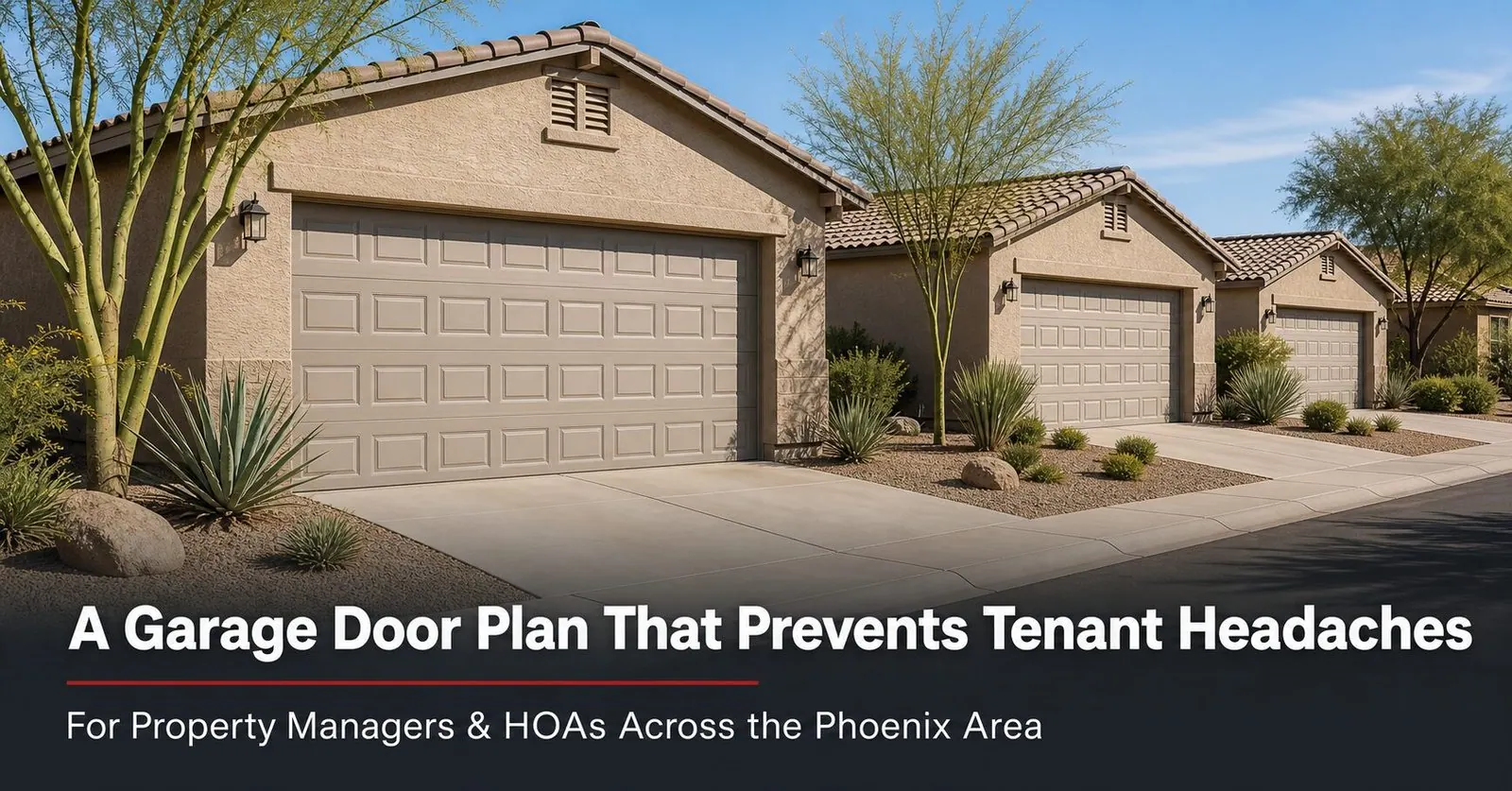
Garage doors punch above their weight in after-hours calls, and almost all of it is preventable. A workable plan for a rental or HOA portfolio in Mesa, Gilbert, Chandler, or Tempe comes down to five moves:
- One planned service visit per door, per year — semi-annual on shared drives and heavy-use units
- A short door check at every turnover — six items, done before the new tenant gets the keys
- Batch by neighborhood — group doors geographically instead of dispatching one emergency at a time
- Track springs by age, not by symptom — they're the single biggest source of "my car is trapped" calls
- Keep two lines of history per door — last service, what was replaced, what was deferred
Ready to put a portfolio on a schedule? Start with our garage door tune-up service.
Every property manager knows the call. It's a weekday morning, a tenant is late for work, and the garage door won't lift — with their car sitting behind it. Nothing about the situation is negotiable. There's no workaround, no "we'll get to it Thursday," and no version of the conversation where the tenant is in a good mood.
What makes garage doors frustrating to manage isn't that they break often. It's that they break completely. A water heater gets lukewarm before it quits. An AC unit struggles for a week. A torsion spring works perfectly on one cycle and is a 200-pound paperweight on the next. That failure mode is exactly why doors generate so many emergency dispatches relative to how simple they actually are.
The good news is that the underlying wear is slow and visible. We service doors across Mesa, Gilbert, Chandler, Tempe, and Queen Creek, and the overwhelming majority of the failures we're called out for had been announcing themselves for weeks. Somebody just wasn't there to hear it. This guide is about building the plan that puts somebody there.
- Why doors generate outsized calls in a portfolio
- The five failures behind most tenant calls
- Setting a service cadence that fits your units
- What a planned visit should actually cover
- The six-item turnover check
- HOA-specific: where the responsibility line sits
- Records worth keeping (and what to skip)
- Batching visits across a portfolio
- FAQs
Why Doors Generate Outsized Calls in a Portfolio
Three things stack up against you in a rental or association context, and none of them apply to an owner-occupied home in the same way.
You lose the early-warning system
An owner hears their door change. They notice the new grinding sound in month two and mention it long before month six. A tenant hears the same sound, decides it's normal for an older house, and reports nothing until the door stops. The information exists — it just never reaches you. A scheduled visit is how you buy that information back.
Arizona wears hardware on a faster clock
Heat thins the lubricant on rollers, hinges, and bearings faster than a temperate climate does, so hardware that would coast in a mild region is running dry here. Then monsoon season blows fine grit into every bearing, track channel, and photo-eye lens on the property. A door on the west-facing side of a Mesa or Queen Creek home sits in direct afternoon sun for years, and the cumulative effect on seals, plastic opener housings, and spring steel is real.
Doors get used harder in multi-occupant units
A single-family owner might cycle a door four times a day. A rental with two working adults and a teenager can double that without anyone noticing. Since spring life is measured in cycles rather than years, that difference cuts the expected life of a standard spring roughly in half. We wrote more about that math in our guide to garage door spring lifespan and cycle ratings.
The Five Failures Behind Most Tenant Calls
Different neighborhoods, different door ages, same short list. Here's what actually generates the calls, in rough order of how disruptive each one is.
- Broken torsion spring. The one that traps a car. On a two-spring door both springs share a single shaft above the opening, so the door doesn't tilt when one snaps — it simply becomes far too heavy for the opener to lift, and the opener strains or gives up. Warning signs beforehand: a visible gap in a coil, rust flaking off the spring, a door that's gotten noticeably heavier on manual lift, or one that drifts down instead of holding. This is planned spring repair waiting to happen, if you catch it.
- Safety sensors out of alignment. A bumped bracket, a spider web, a dusty lens, or a storage bin nudged into the beam. The door closes partway and reverses, and the tenant assumes the opener is dying. It's the cheapest problem on this list and one of the most common calls. Our explainer on how garage door safety sensors work is worth forwarding to tenants directly.
- Worn rollers and bearings. Grit plus heat equals rollers that skid instead of turning. It's audible for months as grinding or chattering during travel, and if it's ignored long enough the wear transfers to the track, which turns a small part into a bigger repair.
- Frayed or slipped cables. Lift cables fray at the drum and can slip off entirely, which pulls the door crooked in its tracks. A door that looks visibly tilted or that binds on one side should come out of service until someone looks at it, not get cycled a few more times to see if it sorts itself out.
- Opener failure after a power event. Monsoon season brings surges and outages, and older opener logic boards don't always survive them. The tell is a unit that responds to nothing, or responds erratically, starting the day after a storm.
Setting a Service Cadence That Fits Your Units
There's no single right interval for a whole portfolio, because a door on a quiet single-family rental and a door on a shared-drive duplex live very different lives. Sort your units into these rows and the schedule mostly writes itself.
| Unit type | Typical daily cycles | Suggested interval | Watch closely |
|---|---|---|---|
| Single-family rental, single occupant or couple | 3–5 | Annual + every turnover | Spring age, seals, sensor alignment |
| Single-family rental, family or multiple drivers | 6–10 | Annual + every turnover | Spring cycle life, rollers, opener strain |
| Duplex / shared drive | 10–20 | Semi-annual | Springs, cables, track alignment |
| Short-term rental with frequent guest turnover | Highly variable | Semi-annual | Keypad codes, remotes, manual release misuse |
| HOA common-area or service door | 20+ | Quarterly | Counterbalance duty rating, safety devices |
Two adjustments for Arizona. First, if a unit sits on a dirt approach, near active construction, or at the edge of open desert, move it one row tighter — dust is the accelerant on nearly every wear item above. Second, aim the annual visit for fall if you can. Coming out of a Phoenix-area summer is when lubricant is most depleted and seals are most degraded, and it puts the door in good shape before the heaviest holiday-season use. Our post on how often to service a garage door in Arizona's heat goes deeper on the seasonal logic.
What a Planned Visit Should Actually Cover
A real tune-up is more than a shot of lubricant. When a tech is at one of your units, this is the scope that earns the visit — and it's reasonable to expect all of it from whoever you hire.
- Balance test. Opener disconnected, door lifted by hand. A correctly balanced door holds roughly halfway on its own. If it slams down or shoots up, the spring tension is off and the opener has been compensating — which shortens the opener's life too.
- Spring, cable, and drum inspection. Coil condition, gap check, cable fray at the drum, drum seating. This is where a future emergency gets caught.
- Rollers, hinges, bearings, and track. Play in the rollers, cracked hinges, track alignment and fasteners. Worn rollers get flagged for replacement before they chew up the track.
- Correct lubrication. Springs, hinges, rollers, and bearings — not the tracks. Tracks are meant to be clean and dry; lubricating them collects the exact desert grit you're trying to keep out.
- Two separate safety tests. The photo-eye reversal (break the beam while closing) and the mechanical reversal (an obstruction on the floor). These test different systems and both need to pass.
- Opener force and travel limits. Drifted limits are behind a surprising share of "closes then opens back up" complaints.
- Weather seal and bottom seal. Arizona sun cracks bottom seals, and a failed seal lets in heat, dust, and the occasional scorpion — which becomes a tenant complaint, not a maintenance item.
- Manual release check. Cord present, reachable, and functional. Tenants need this to work in an outage, and half the time it's been zip-tied up out of the way.
Ask your tech to walk you (or the on-site contact) through what they found before they leave. The conversation is where the value is — you'll hear which items are urgent, which are watch-list, and roughly how much life is left in the springs. Jot the highlights into your own system while it's fresh.
The Six-Item Turnover Check
Turnover is the one moment you have unrestricted access and no tenant to coordinate with. Use it. This takes a few minutes and belongs on the same clipboard as the smoke detectors and filters.
- Full cycle, listening. Open and close once. Grinding, popping, chattering, or a hitch in the travel means it goes on the service list.
- Photo-eye test. Start the door closing and wave something through the beam. It must reverse immediately.
- Mechanical reverse test. Lay a solid object flat on the floor in the door's path. The door should contact it and reverse. If it keeps pushing, the force setting is wrong and it's a safety issue, not a convenience one.
- Balance test. Pull the manual release with the door closed, lift by hand, and let go at waist height. It should mostly stay put.
- Manual release cord. Present, hanging free, and reachable. Show it to the incoming tenant and explain when to use it.
- Remotes and codes. Count every remote back in, reset the keypad code, and clear old remotes from the opener's memory. Most openers clear all paired remotes by holding the learn button until the indicator goes out — check the manual for the model. A previous tenant's remote still working is a real security gap.
HOA-Specific: Where the Responsibility Line Sits
Associations run into a different problem than property managers do. It's rarely about who fixes a broken door — it's about who is allowed to, and who has to.
Confirm the line, don't assume it
In most Arizona communities the homeowner owns the garage door and opener on their own unit, while the association owns anything on common area: parking structure doors, maintenance and storage building doors, and gated or roll-up service openings. But governing documents vary, and attached-product or condo-style communities sometimes place the door itself with the association. Read the CC&Rs before a board makes a promise either direction.
The gap boards keep discovering the hard way
Appearance standards and maintenance responsibility often don't line up. An association can require that doors match an approved color and style, cite an owner for a faded or dented door, and still have no authority or budget to service the mechanism behind it. That's a defensible position — it just needs to be stated plainly in owner communications so nobody assumes the association is quietly handling upkeep.
Where a board can add real value
- Common-area doors on a quarterly schedule. These cycle far more than any single home's door and are the association's clear responsibility.
- An approved-vendor list. Owners overwhelmingly want someone recommended rather than someone found in an ad. A vetted, licensed, insured local option in the newsletter is a genuine service.
- A seasonal reminder. One note before monsoon season and one after summer, telling owners what to listen for. It costs nothing and reduces the number of doors that reach failure.
- A community service day. Some associations coordinate a block of tune-ups on the same date so owners get scheduled efficiently. Owners pay individually; the association just organizes the calendar.
Records Worth Keeping (and What to Skip)
You don't need a maintenance management system for this. You need about two lines per door, per visit, in whatever software you already use.
| Record | Why it earns its space |
|---|---|
| Opener brand and model | Resolves more phone questions than anything else. Photograph the label once and you never look again. |
| Approximate door and opener age | Drives the repair-versus-replace conversation before it becomes urgent. |
| Date springs were last replaced | The single most useful number in the whole file. Springs are a scheduling item once you know the date. |
| Parts replaced, by visit | Tells you whether a recurring complaint is actually recurring, and whether a repair is still under warranty. |
| Deferred items you were told about | Turns "why didn't anyone warn us" into a dated note. Also builds your next planned-work list. |
| Turnover photos | Settles damage questions without a debate. Three angles, every move-in and move-out. |
One exception on the documentation front: if your portfolio includes a fire-rated commercial door — common on multi-tenant buildings and maintenance structures — those carry a separate legal requirement under NFPA 80 for a documented annual inspection, with records retained and produced for the fire marshal on request. If nobody on your team can name who handles that for a building you manage, it's worth resolving this month.
Batching Visits Across a Portfolio
This is the part that changes the economics, and it's entirely within your control.
Handling doors reactively means every incident is an emergency dispatch, coordinated with a tenant who's already having a bad morning, at whatever moment the door chose. Handling them proactively means grouping doors by geography and scheduling them together, with access arranged in advance and a tech who can work through several units without crossing the valley between each one.
Portfolios clustered in Mesa, Gilbert, Chandler, or Queen Creek batch especially well, since drive time between units is short. Even a loose grouping helps — four doors in one zip code on one morning is a meaningfully different job than four doors scattered across four weeks.
- Group by neighborhood, not by due date. A door that's a month early is fine. A separate trip is not.
- Give tenants one notice with a window, not a scramble. Planned access is far easier to arrange than emergency access.
- Handle deferred items on the next planned pass wherever safety allows, instead of booking a return trip for each one.
- Keep one emergency lane open. Springs and cables don't wait for the schedule — that's what 24/7 emergency repair is for.
When you call, tell us how many doors you have and roughly where they sit. We'll build the route around your access windows rather than making you fit ours.
Why Property Managers in Mesa Call Farnsworth
Farnsworth Garage Door Service was founded by brothers Brigham and Riley Farnsworth. The Farnsworth name carries 60+ years of family business across Mesa and the East Valley — R&K, Farnsworth Wholesale, Farnsworth Realty — so we understand what it means to be the vendor someone else's reputation is riding on.
- We'll route around your portfolio — tell us how many doors and where, and we'll batch them into planned visits instead of one-off dispatches.
- We talk to your tenants like neighbors, because in Mesa, Gilbert, and Chandler they usually are. How we handle the door is part of how your tenant experiences you.
- We tell you what we found and what it means — in plain terms, in the walkthrough, so you can decide what's urgent and what waits for the next pass.
- Licensed and insured Arizona ROC contractor with a 5.0-star Google rating from customers across Mesa, Gilbert, Chandler, Tempe, and the wider Phoenix area.
- Same-day service is our standard — often within hours of your call — for the doors that can't wait for the schedule.
See everything we handle on our garage door repair and service page, or the local details on our Mesa garage door repair page.
Frequently Asked Questions
How often should garage doors be serviced on a rental property in Arizona?
Once a year is the baseline for a single-family rental in a normal residential use pattern, and that's the schedule most owner-occupied homes follow too. Rentals earn a tighter interval for two reasons. First, you don't get to observe the door day to day the way an owner does, so early warning signs go unreported until they become failures. Second, Arizona heat and dust wear hardware faster than a mild climate does. For most portfolios across Mesa, Gilbert, and Chandler, an annual visit per door plus a check at every turnover is the practical rhythm. Doors on shared drives or above 15 cycles a day belong on a semi-annual schedule.
What causes the most emergency garage door calls in rental properties?
Broken torsion springs, by a wide margin. A spring is the one component that fails completely and without a partial mode — the door works normally on the last cycle and is unliftable on the next, usually with a tenant's car sealed inside. After springs it's safety sensor misalignment, worn rollers and bearings, frayed or slipped cables, and opener failures after a monsoon power event. Nearly all of these give weeks of warning in the form of new noise, slower travel, or a door that needs a second button press.
Should a maintenance plan cover doors in an HOA community or only the units themselves?
That depends on where the association's responsibility line sits in your CC&Rs, and it's worth confirming rather than assuming. In many Arizona communities the homeowner owns the door and opener while the association owns anything on common area — parking structure doors, maintenance building doors, gated or roll-up service openings. A common gap: doors that are technically homeowner-owned but visible from the street and subject to appearance standards. The association can require the door to look a certain way while having no mechanism for keeping it working. Naming that gap out loud, in writing, saves boards a lot of argument later.
What should a garage door check at tenant turnover include?
Six things, and it takes minutes. Run the door through a full open and close cycle and listen for anything new. Test the safety reversal by blocking the photo-eye beam. Test the mechanical reverse with a solid object under the door. Do a balance test with the opener disconnected — the door should hold roughly halfway on its own. Confirm the manual release cord is present and reachable. And account for every remote and keypad code, then reset the keypad code before the new tenant moves in. That last one is a security item more than a maintenance item, and it gets skipped constantly.
How do I know if a garage door spring is close to failing?
Springs are rated in cycles rather than years, so the question is really how much of the rating has been spent. A standard residential spring is often rated around 10,000 cycles, which is roughly seven years at four cycles a day but only about three and a half years at eight. Visual signs include a visible gap in the coil, rust or flaking on the coil surface, and a door that has started to feel heavier on manual lift or that drifts down instead of holding position. If a door in your portfolio is past year seven on original hardware, treat spring replacement as a scheduling decision rather than an emergency waiting to happen.
Do tenants ever cause garage door damage, and how do I document it?
Sometimes, and the two most common are backing a vehicle into a partially open door and pulling the manual release while the door is up. Both produce distinctive damage — a creased or dented panel and bent track in the first case, a door that has come off its counterbalance in the second. The way to keep these conversations simple is to photograph the door at move-in and move-out from the same three angles: full exterior, interior with the door closed, and a close shot of the bottom section and track. Wear is expected. A bent track is not, and photos make the difference obvious without anyone having to argue about it.
Is it worth batching garage door service across multiple properties?
Yes, and it's the single biggest operational lever a property manager has here. Scheduling doors one at a time as they break means an emergency response for every incident, coordinating access with a tenant who is already frustrated. Grouping doors by neighborhood and scheduling them together turns the same work into planned visits with predictable access. Portfolios clustered in Mesa, Gilbert, and Queen Creek batch particularly well because the drive time between units is short. Call, tell us how many doors and roughly where they sit, and we'll build the route around your access windows.
What records should I keep on garage door maintenance?
Keep a simple per-door history in whatever system you already use: address and door identifier, date of last service, what was replaced and when, opener brand and model, approximate door age, and any deferred item you were told about. Two lines per visit is enough. It answers the questions that come up later — whether a repair is a warranty conversation, whether a door is due, whether a recurring problem is actually recurring. If your portfolio includes a fire-rated commercial door, note that those carry a separate legal inspection and documentation requirement under NFPA 80, and it's worth confirming who's handling that for the building.

Put Your Doors on a Schedule Instead of a Fire Drill
Planned tune-ups, turnover checks, and portfolio routing across Mesa, Gilbert, Chandler, Tempe, and the Phoenix area. Tell us how many doors you manage and we'll build a schedule around your access windows — with a written quote before any work happens.